Last Days of Overlanding – Onward to Cape Town

Tags

, , ,

Spitzkoppe

Spitzkoppe

It was hard to believe but the 56 day coast to coast overland adventure I’d embarked on in Nairobi was coming to a close.  We had three more days on the road after Swakopmund before we’d arrive in Cape Town and I’d start my independent travel in South Africa.

I can’t say I was sad that the trip was coming to an end.  While there were numerous advantages to being on a truck with a planned route, and tour operators arranged for you  in each destination; it was very challenging for me to not have the freedom that independent travel affords.  I was so looking forward to being able to go where I wanted, when I wanted, to stay for as long as I wanted, and most importantly, to spend time with whom I wanted.

Despite my extroversion, I was really looking forward to some alone time as well.

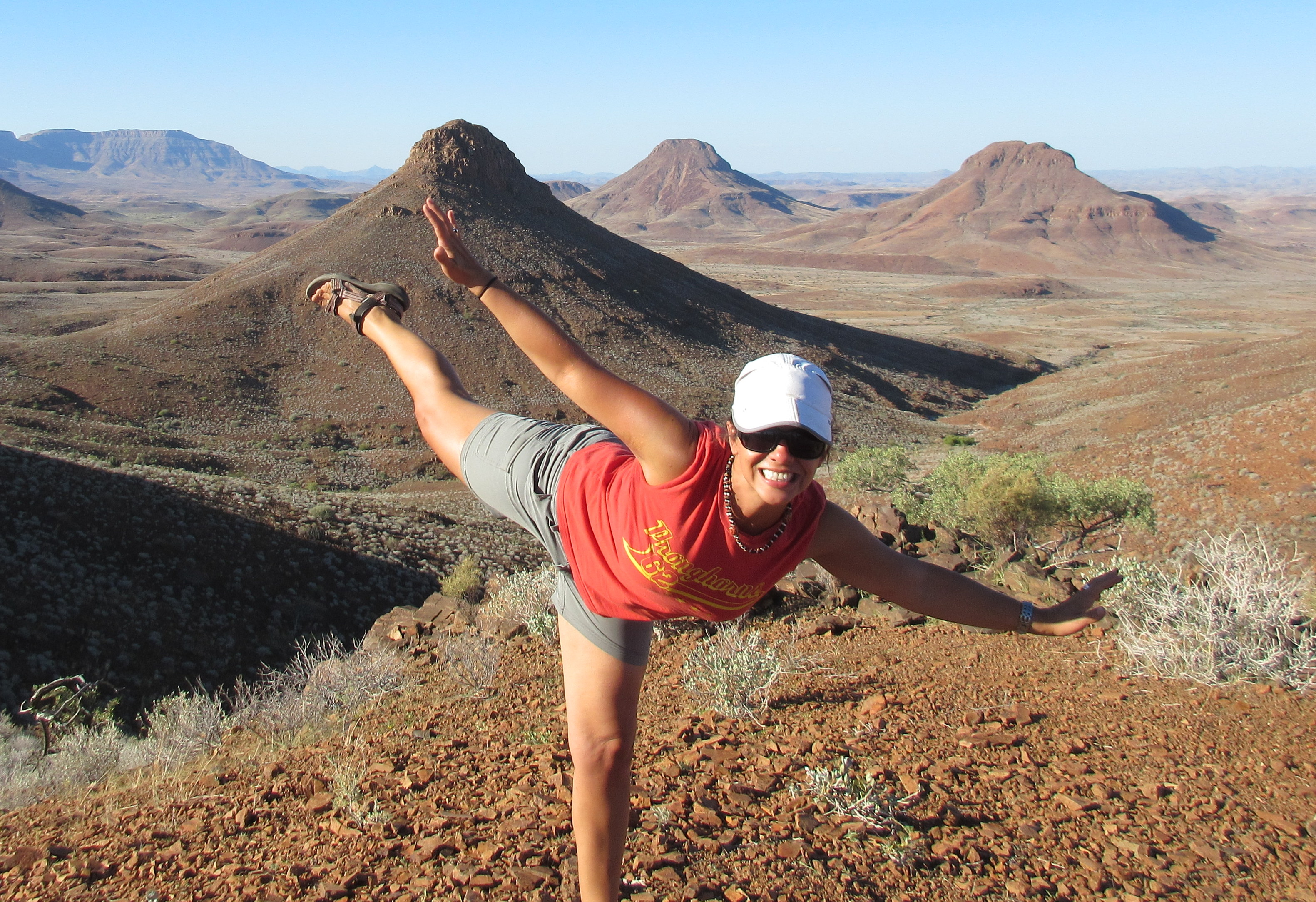
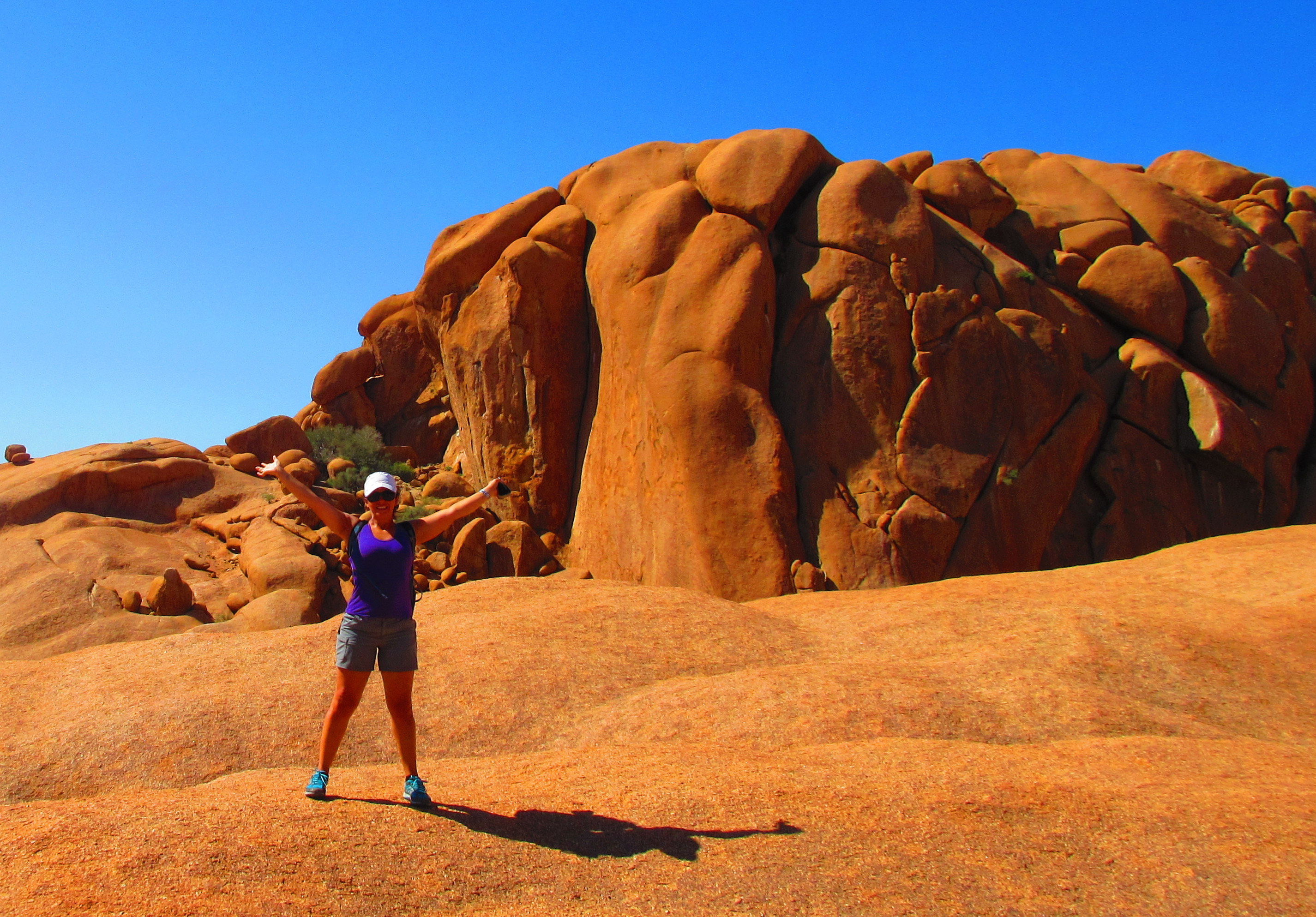
Leaving Swakopmund, our first stop was a beautiful spot in the desert called Spitzkoppe – an area of stunning red rock formations that recalled to mind similar vistas in Arizona/Utah, Australia, and Jordan’s Wadi Rum.  Our group was greeted by two very cute running meerkats who continued to follow us as we embarked on our two hour guided hike through the area.
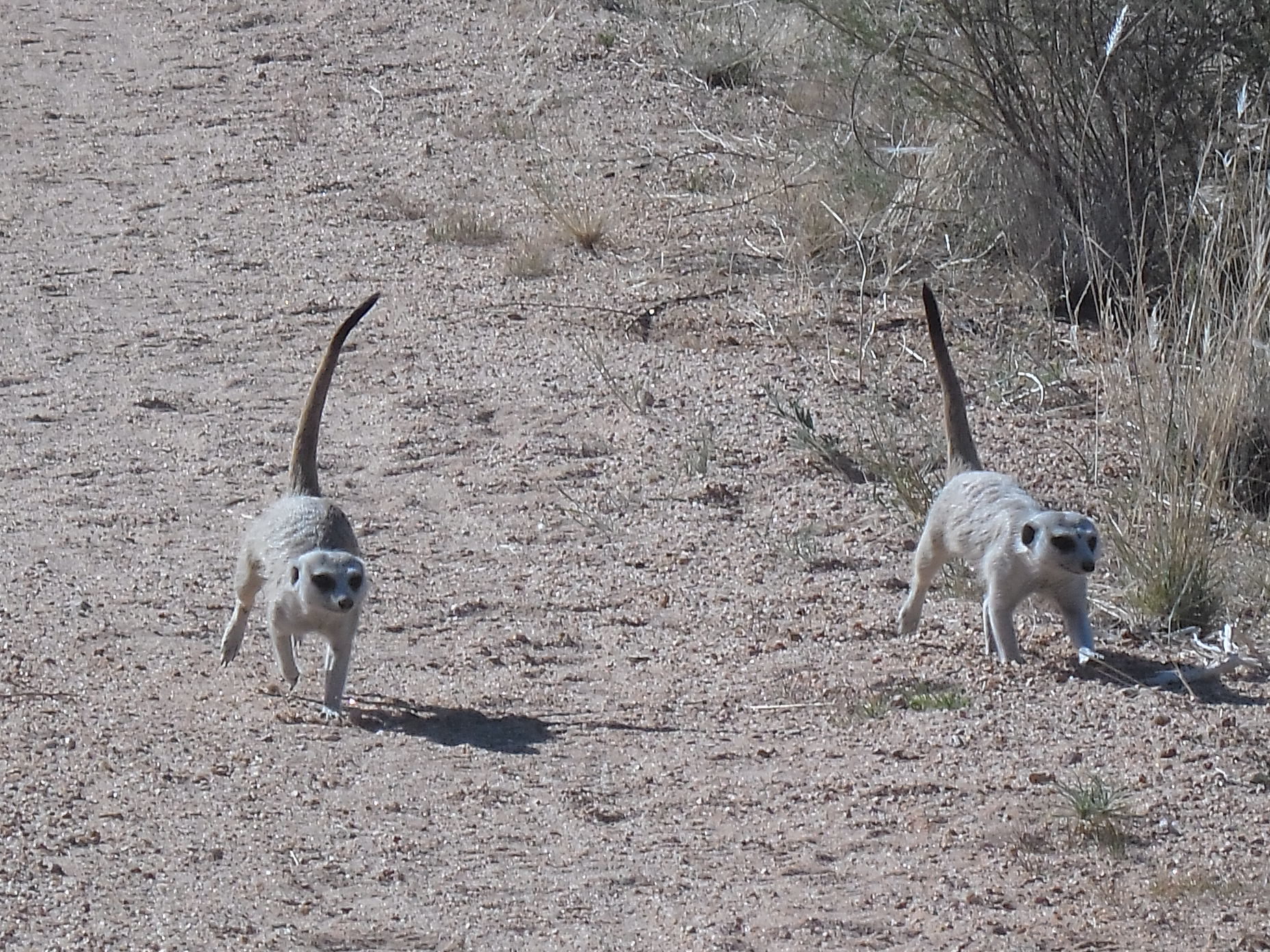
Meerkats following us!

Meerkats following us!

Our guide took us to see some cave paintings and told us a little bit about the history of the San people, whom it is believed created the art.  He also talked about the San language and how it related to his native Tamara – which only contains five clicks as opposed to the Bush people’s seven.

We then hiked to a watering hole, though none of us had our swimsuits, which was unfortunate since it was already swelteringly hot.  It was still a very beautiful place and I thought it one of the most scenic spots we’d stopped at on the trip so far.

The following day we visited a farm in the middle of nowhere – desert all around as far as the eye could see.  We were scheduled to have an afternoon/evening desert tour with a man known locally as “Boesmann” or “Bushman”.  He is a white 4th generation Namibian who bought this dilapidated farm, and renovated it in the hopes that he would be able to make a living offering tours of the desert to tourists passing through the area.
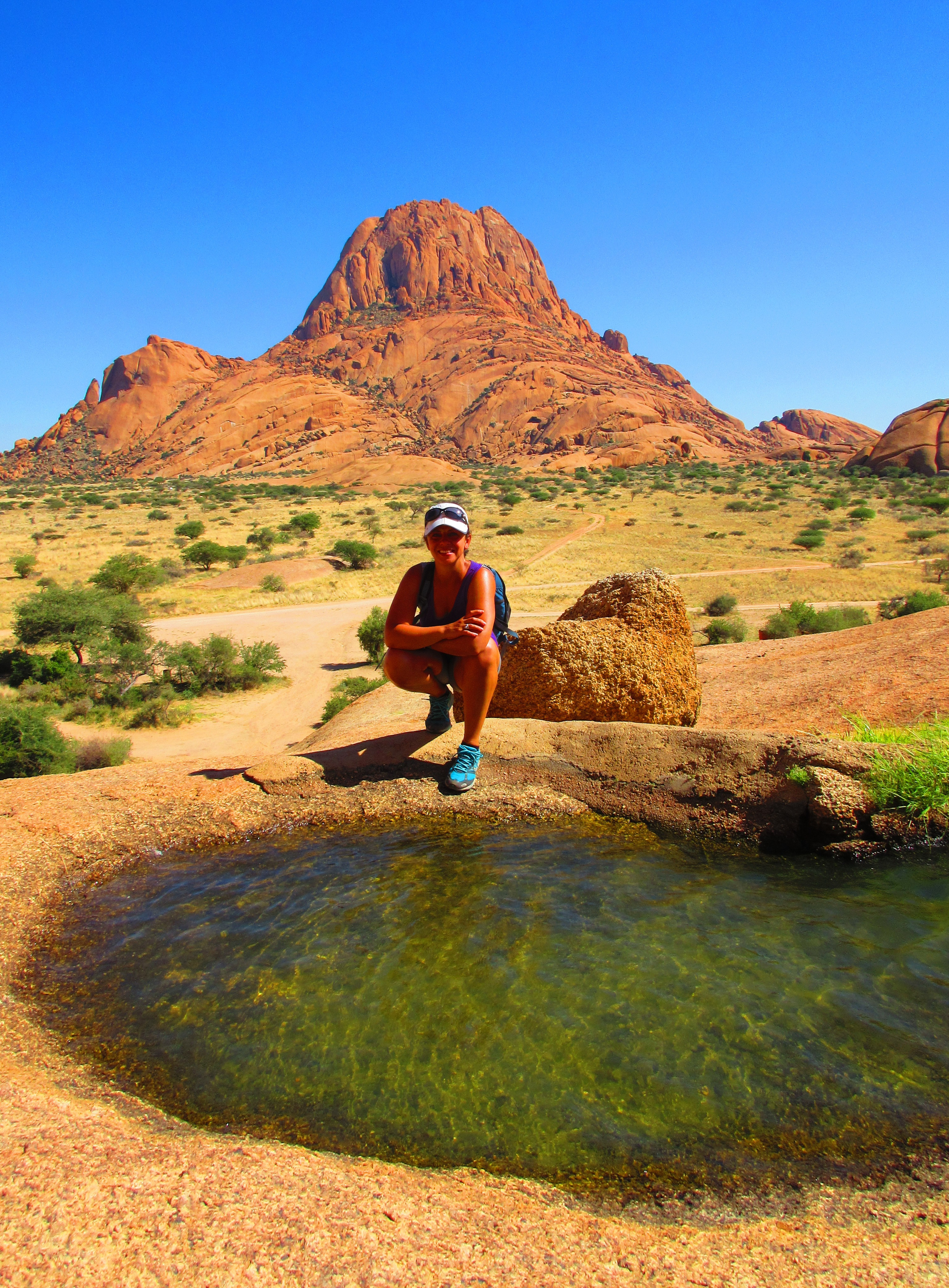
At the watering hole in the hot sun

At the watering hole in the hot sun

The tour itself was very informative and interesting (despite the fact that I found his extremely thick accent somewhat hard to concentrate to) and we learned lots of stuff about desert survival.  A few of the tips I remember:

  • If you’re lost in the desert, never go to a tree.  There might be wild animals there.
  • If you get lost in the desert, split up into small groups.  You have a higher chance of survival apparently
  • The San didn’t drink water.  They would suck on the eyeballs of any hunted Oryx and then wring out their stomachs for liquid that would be provided to the women and children. Sounds thirst quenching.
  • You can eat lizards to stay hydrated.
  • You can never kill a beetle by standing on it in the sand.  It will just go deeper into the sand.
  • Never ever help an oryx out of a fence if he’s stuck in it.  He will gore you to death.  Better call the farmer who’s land the Oryx is on so he can shoot and eat it.

Boesmann also gave us some additional interesting information on the Bushmen.  His grandfather, apparently, had one as a pet. Yes, you read that right – people in Namibia  used to have Bushmen that they kept as pets along with their chickens and dogs.   It was legal to hunt and kill bushmen until 1920.  Isn’t that shocking?

"Bushman" giving us his tour of the desert

“Bushman” giving us his tour of the desert

He talked a little about how nomadic they were and their incredible capacities for gorging themselves on meat if they were lucky enough to make a kill.  He said they could eat 20kg of meat in one go and then they would sleep in order to digest it properly.  He also talked about the realities of their nomadic existence and how if they had gone for some days without finding food, it might have been necessary to leave behind the youngest children who might slow the group down.  It was said that it was best to simply walk away and not look back at the abandoned child, left to die alone in the hot desert.  Since they believe that one should never speak of the dead, the mother would sit by the smoky fire that evening, so that if she cried, she could attribute her tears to the smoke.

Rather heartbreaking, isn’t it?
IMG_0018-001

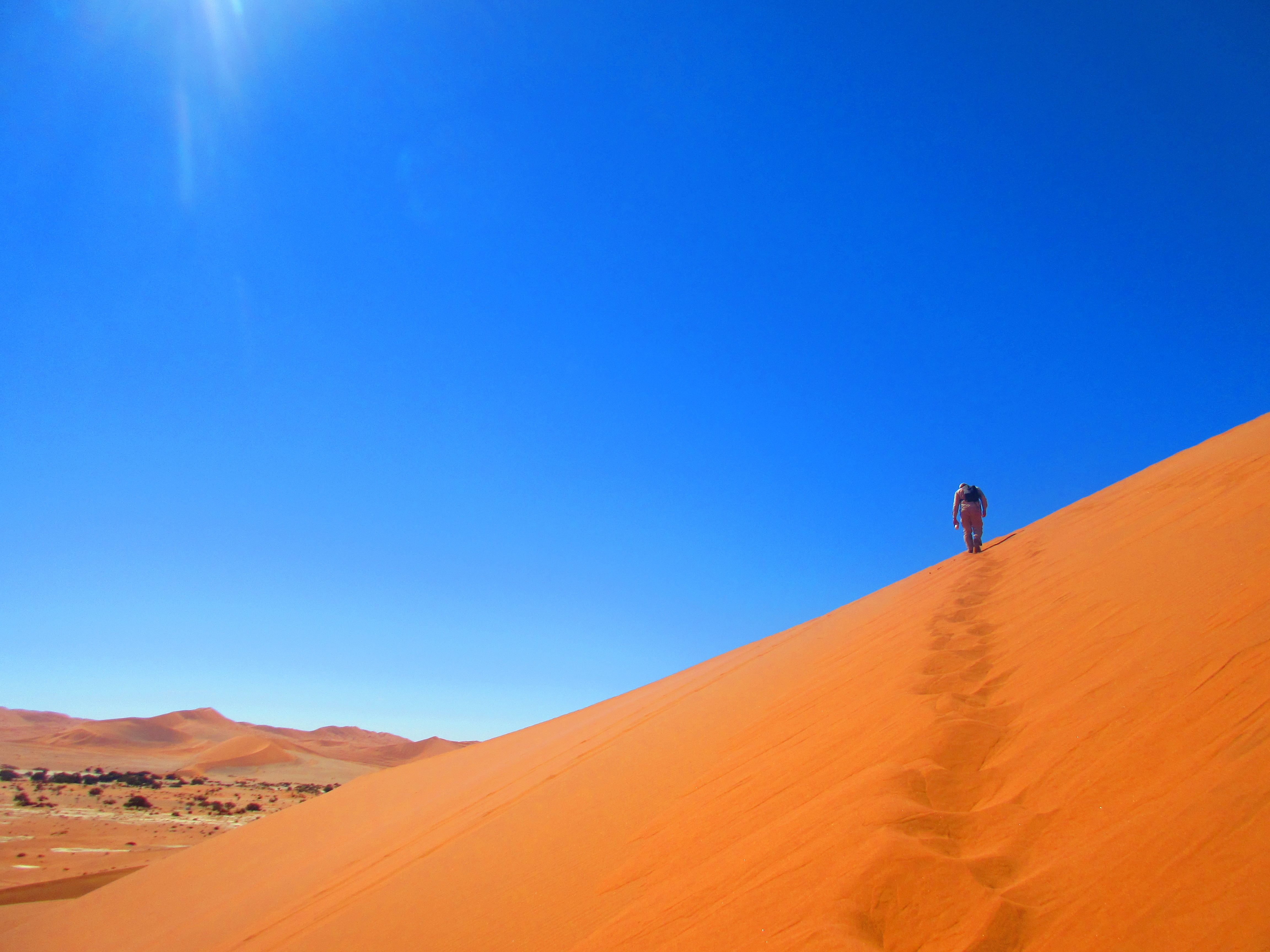
Heading up Soussvlei

Heading up Soussvlei

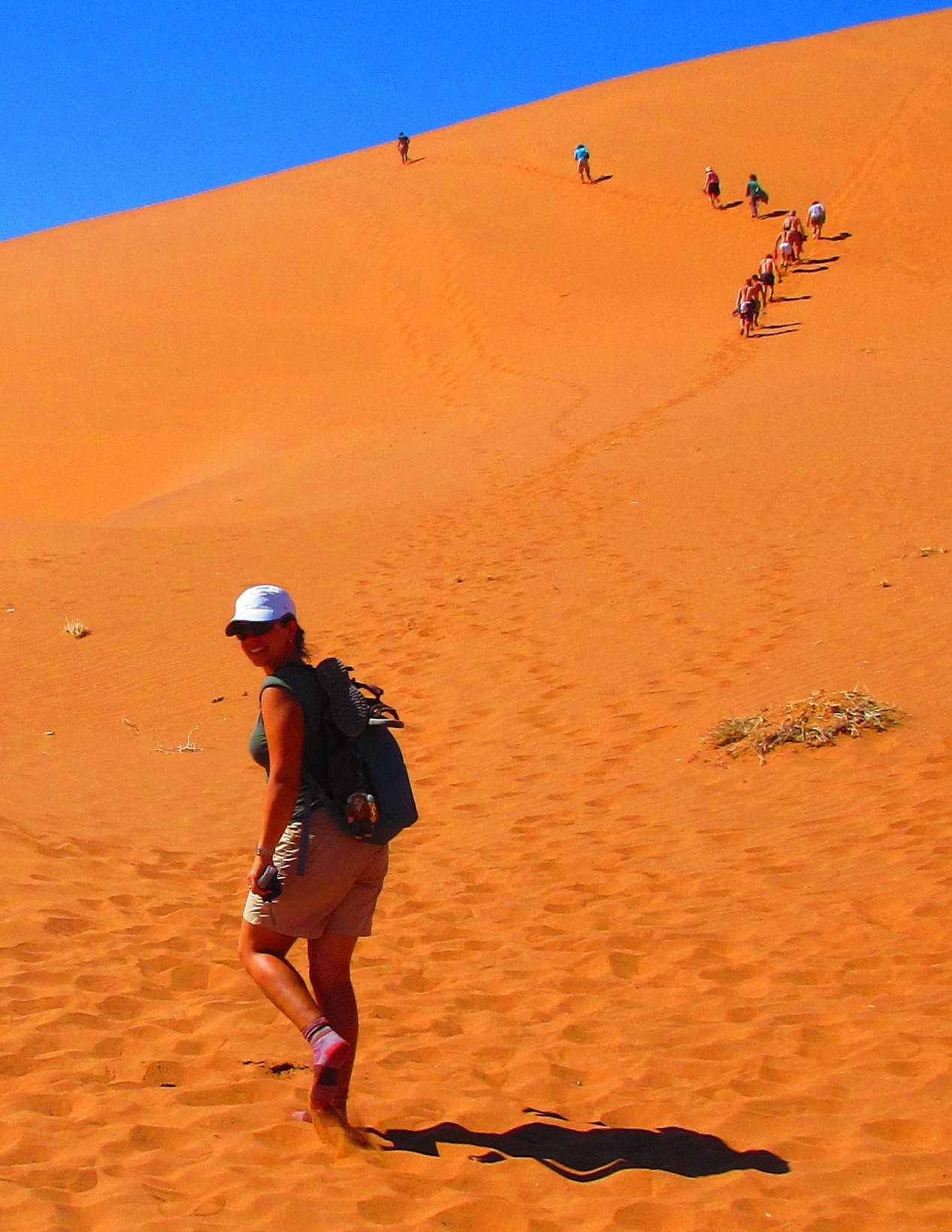
The following day was a day of fun in the hot sand of Soussvlei, Deadvlei, and Dune 46 – the largest free standing sand dune in the world.  At Soussvlei, we arrived, much to our chagrin, at 12pm – the hottest part of the day when the sun was at its strongest point.  Doing our best to stay hydrated and not get fried to a crisp, we set out on what we thought was a guided tour of the dunes, but we were simply dropped off in a jeep and given no additional information.  Not really sure what we were expected to do – we hiked up the main ridge of the dune and then had a whale of a time running back down (this is by far the most enjoyable part of climbing sand dunes)  Upon our return, we found out that we weren’t actually supposed to climb the dune because we were climbing Dune 45.  What the hell?!

Personally, I was fine with climbing both and welcomed the exercise very much indeed.

That night we enjoyed a beautiful setting for our final bush camp experience.  The setting was lakefront and the only thing that spoilt the location was the amount of trash that had been left behind by previous groups.  Since we’d gotten in before sunset, I suggested that we play the game of charades that the group had so enjoyed together at Okavango Delta.  It was a fun evening until another fight broke out within the group.  Apparently someone thought it funny to put trash in someone else’s locker.  Group dynamics had been somewhat dramatic on this journey, though I suppose that can be expected when you spend this amount of time on a truck.

Quatchi likes the dunes too

Quatchi likes the dunes too

Our final day of the tour itself was initially not even going to happen when Pete discovered the following morning that the truck wouldn’t start.  Panic was soon subsided by the fact that our driver is a mechanical genius, and within an hour he’d replaced whatever vital part wasn’t functioning before and we were on our way.

Our only stop this day was the second largest canyon in the world – Fish River Canyon in the very south of Namibia.  We only had two hours there but it was enough to get a good long walk in to the various lookouts over the edge of the canyon.  I had read about the five day trek that one can do through the canyon, skirting the river along the canyon floor, but the only way to do it non-independently was with a tour operator that was charging well over a $1000 for it.  I would have loved to climb down and see how the views changed based on where you were inside its vertical walls.
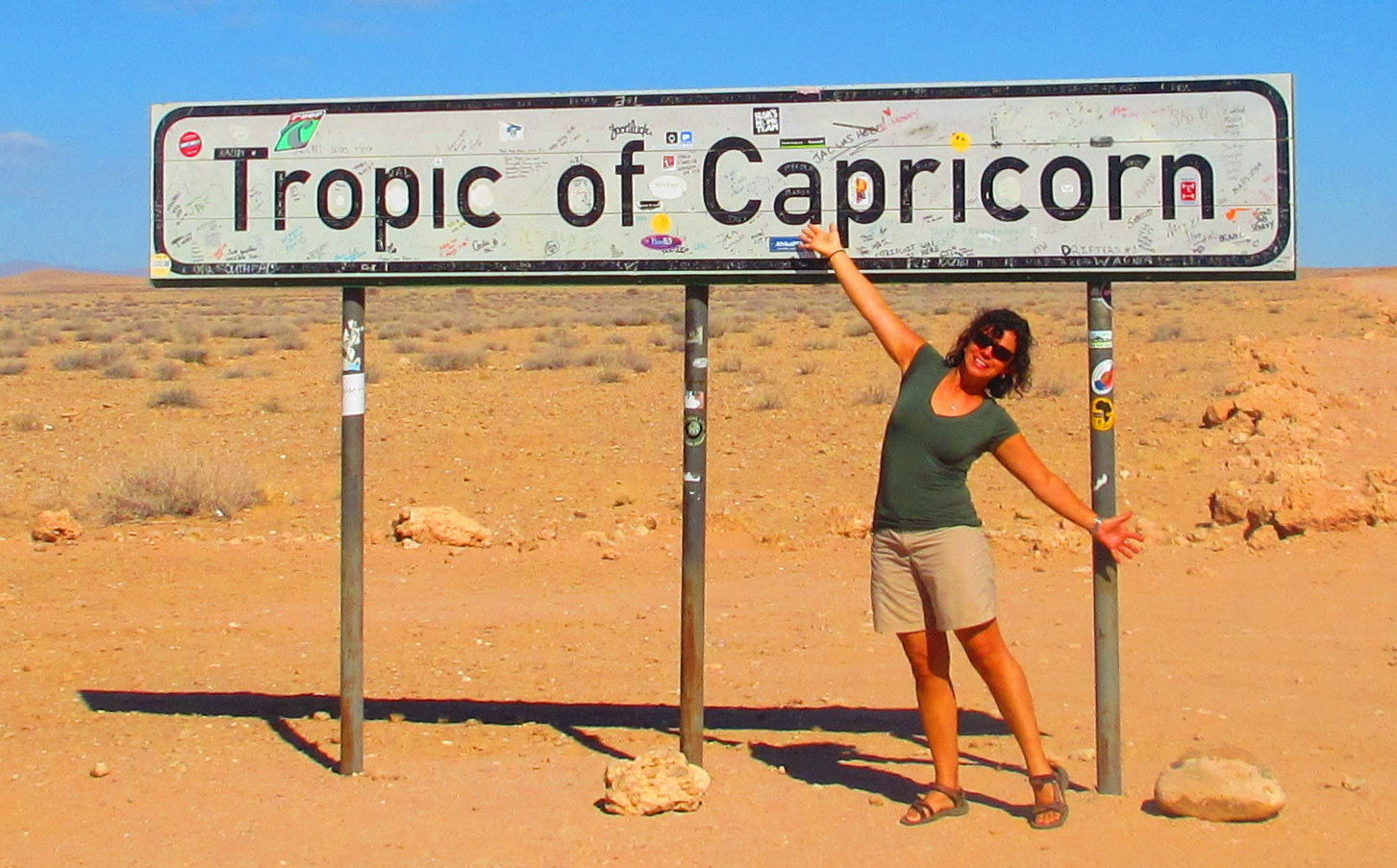
Crossing the Tropic of Capricorn

Crossing the Tropic of Capricorn

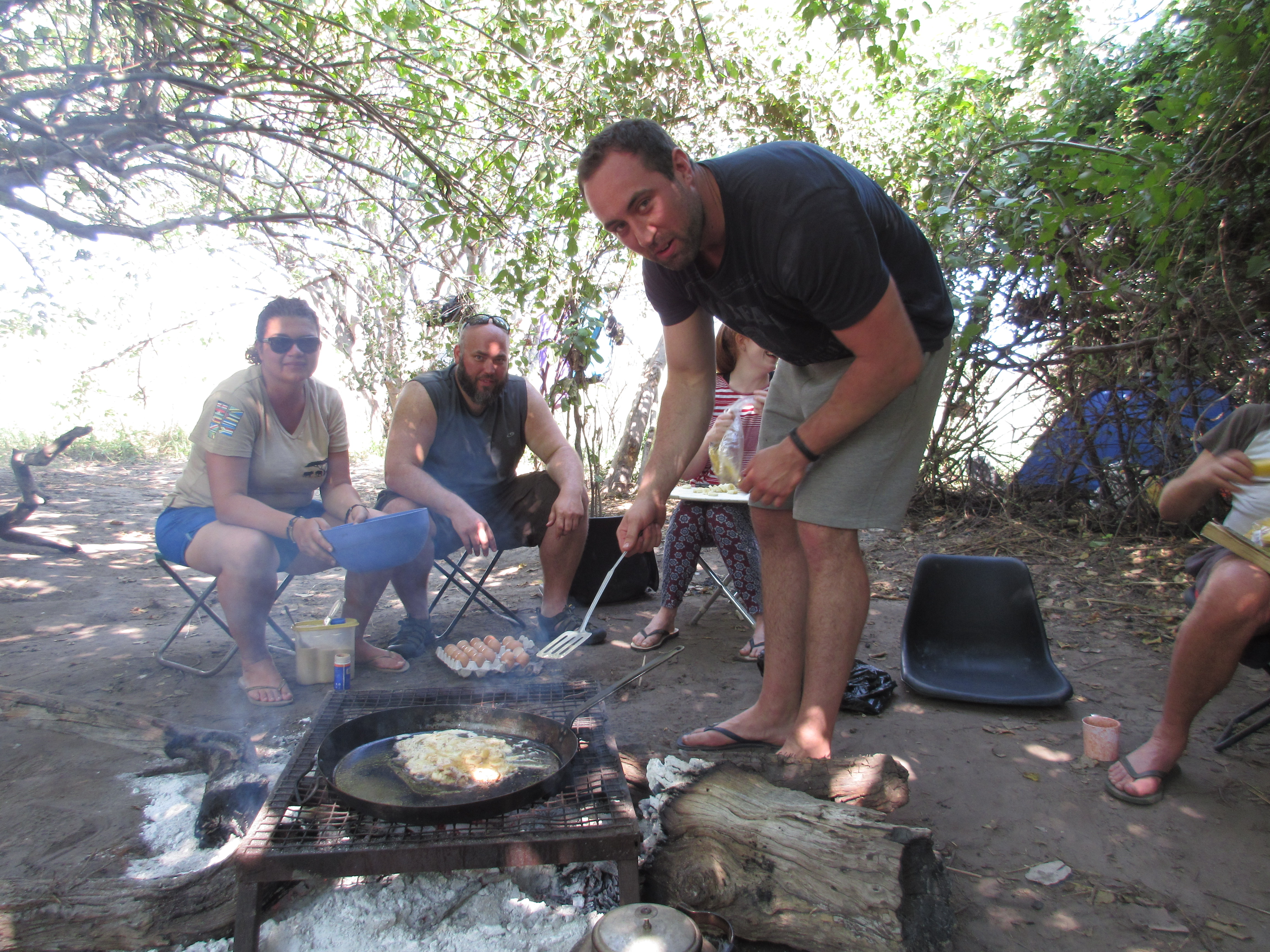
Our last night was at a lovely campsite ran by the same coach company – Felix Unite –  that was going to be transporting us in the very early morning to Cape Town.  I had cooking duties this last night, and we made Spanish omelettes, Potato wedges and guacamole.  It was delicious, and I’m finally unafraid of making omelettes!

I re-packed all of my bags, as Tabitha and Pete were kind enough to take a bag from me and transport it back with them to Nairobi where I would be re-joining them in a few weeks.  At first I wasn’t sure if I was going to do the Gorilla Loop tour that lasts 18 days, but since it was going to cost me $375 just to change my international plane tickets, and I did have the time at the moment (if not the funds) I had decided that I was going to go to Uganda and Rwanda after my nearly 3 weeks in South Africa.
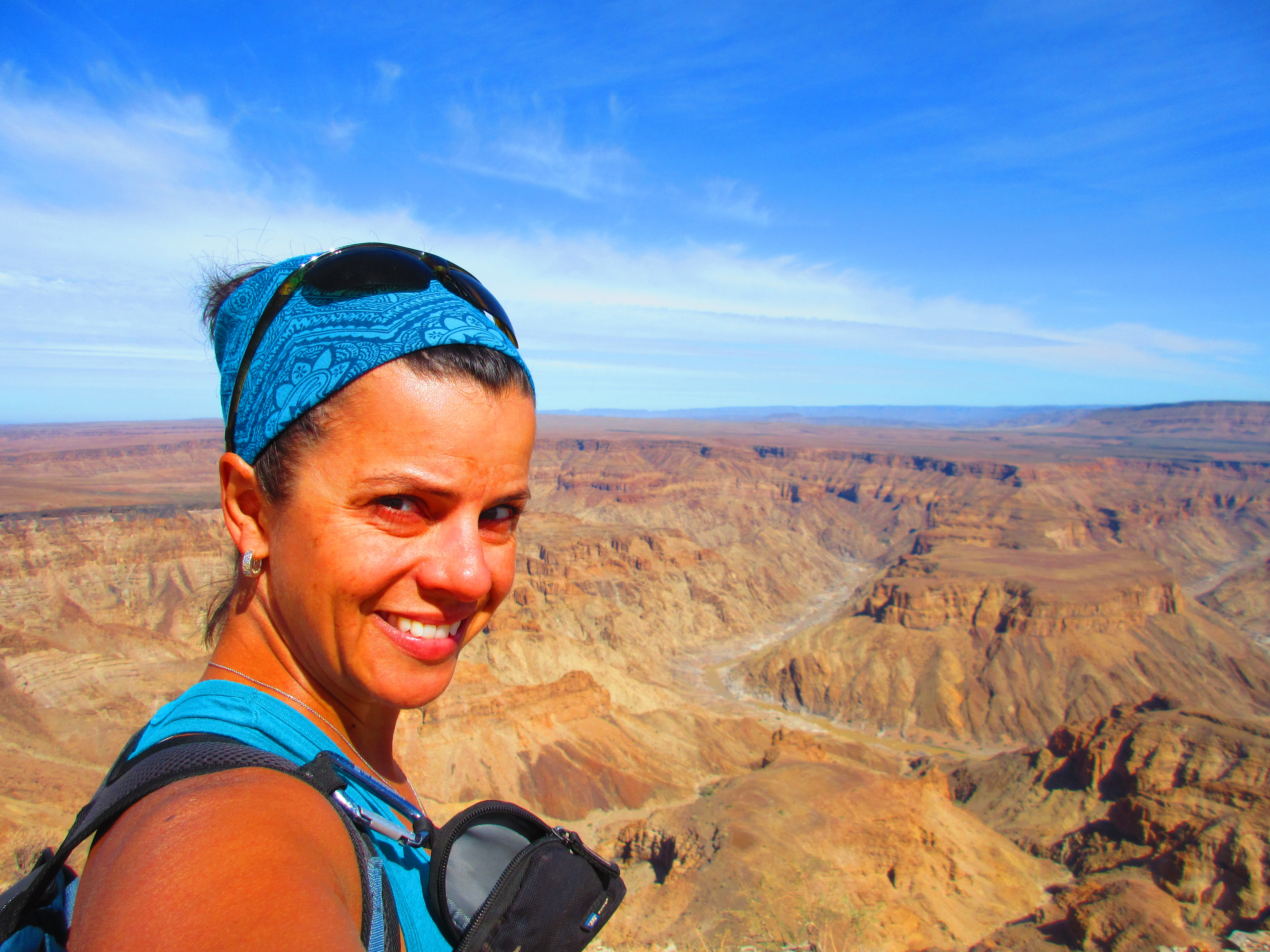
At Fish River Canyon

At Fish River Canyon

This trip has really challenged me in many ways that I was not expecting.  At first, it was all too much and I very much regretted coming, and yearned to go home where things were known to me and predictable.  I missed my friends.  I missed having someone to talk to.  And I still do – travel can be a very lonely experience if you haven’t anyone to share it with.  However, I have fallen for the spirit of Africa and made a decision to stick with my original plans and take each day as it comes.  This is what will make me a stronger person – I hope.

I was so looking forward to returning to South Africa, almost 14 years after I had first visited on Semester at Sea.
Swakopmund – Bizarre German city in the desert

Tags

, ,

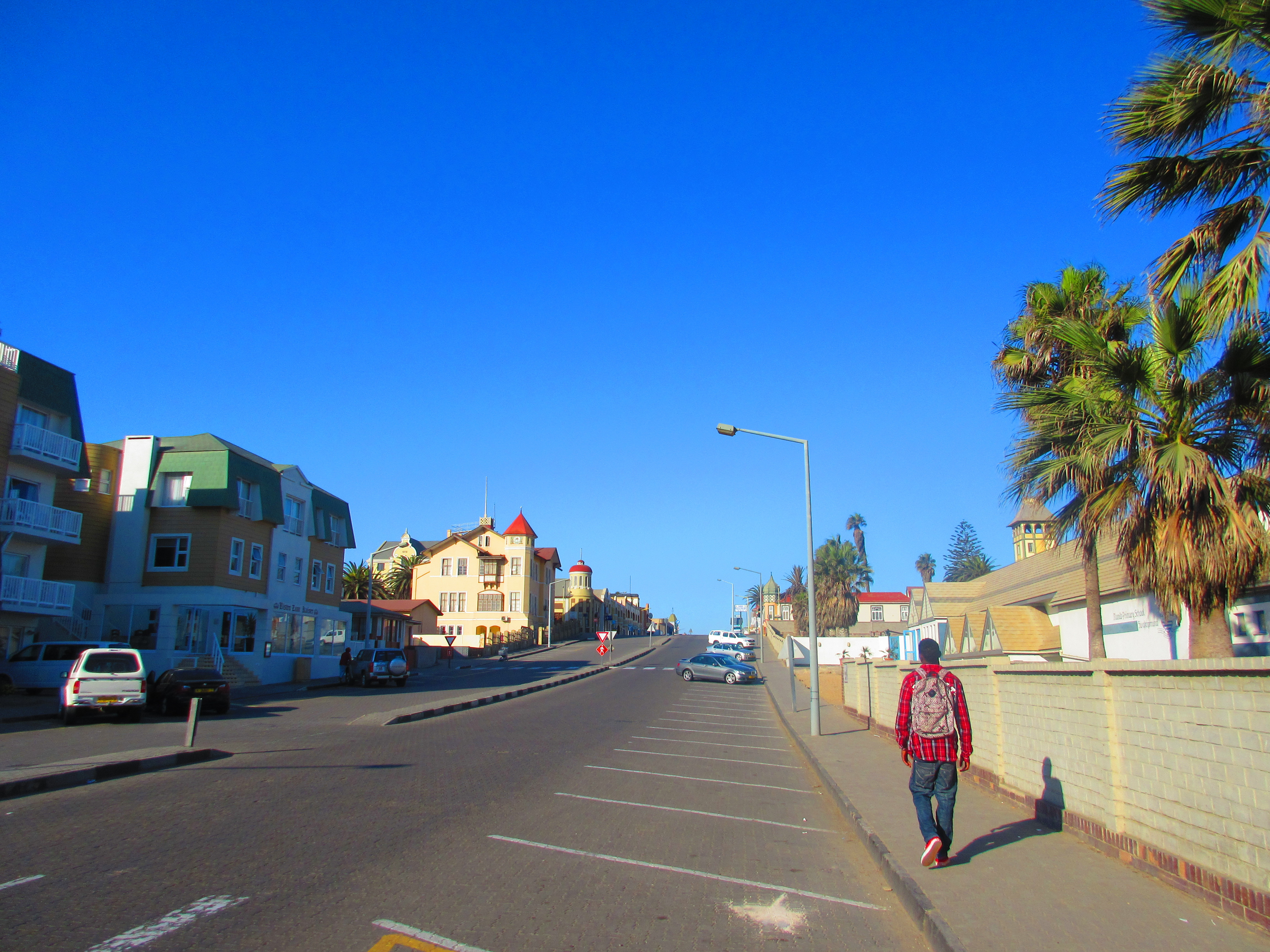
IMG_0013Swakopmund just looks funny.  It isn’t congruent with any sort of mental image one has of a city in Africa.  Granted, that initial image is often quite misdirected to start with, given the shamefully limited amount of exposure we Americans get to African news/culture/history.   It’s German influence was clearly visible; from its architecture and the manicured design of its streets to its cold meats at breakfast.  The language of the predominantly white city population, however, was Afrikaans and the people were fiercely Namibian (which they made very clear if and when it came up in conversation).

The restaurants were overpriced compared to other stops we’d made, the meals costing roughly what they would back home.  It was nice, however, to order some really well prepared fruit smoothies, western wraps, and grilled steak.  There was a distinctly European feel to everything in that city and one could easily forget they were on the African continent.

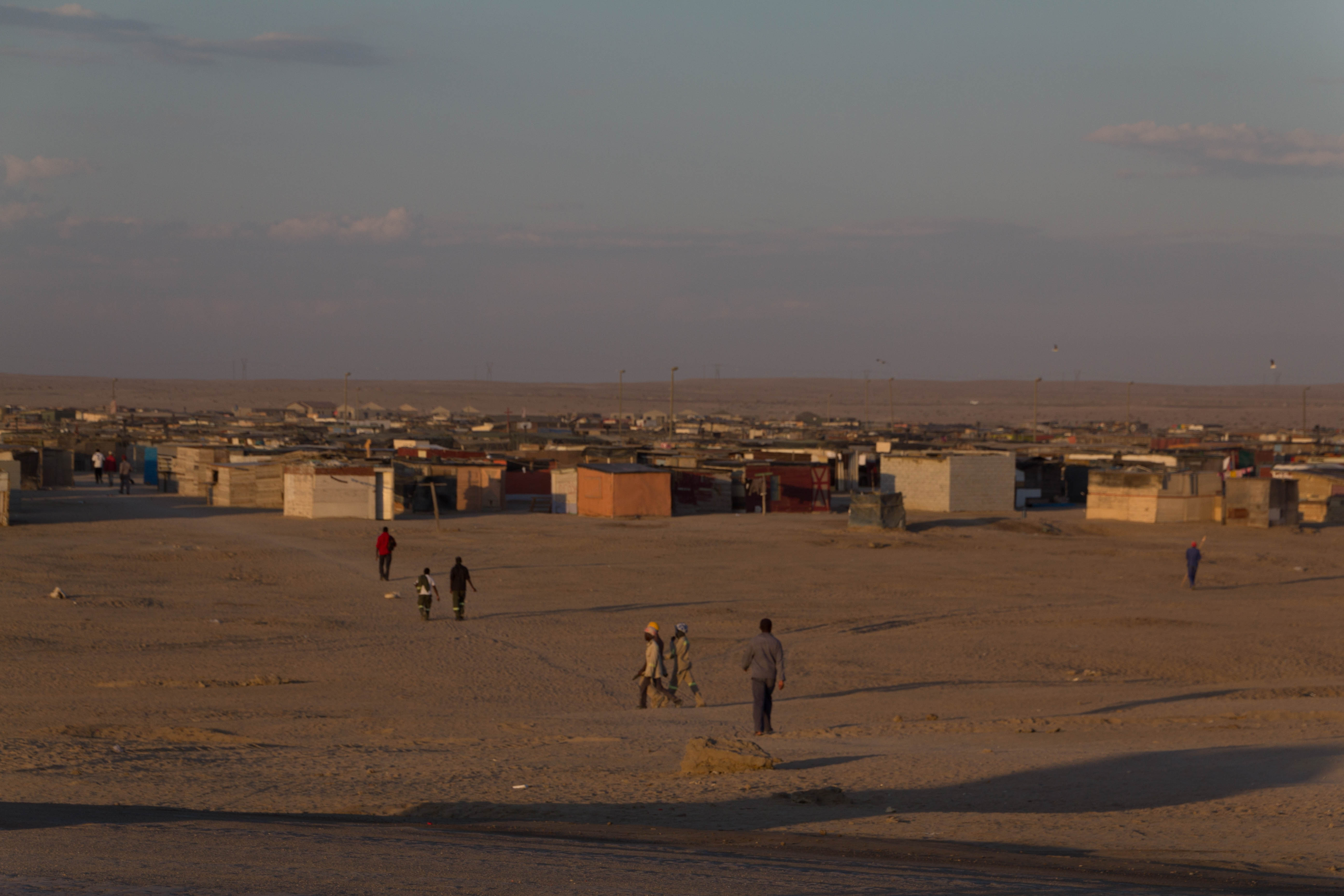
That is, until you ventured even a few blocks outside the city.  Like major metropolitan areas in South Africa (and South Africa governed Namibia until it gained independence in 1964) – Swakopmund is surrounded by sprawling townships, the raw materials utilized in the their construction getting progressively more temporary and non-robust the further out of the city you went, like the outer layers of an onion.  Swakopmund’s main industry is mining – and people come from all over the country with the promise of better wages in the urban areas.  However depressing, 90% of Swakopmund’s population live in the townships – and they are all people of color, known in Namibia as Black and colored (anyone with mixed blood/race), yet they earn/retain only 10% of its wealth.  That is the reality here.  Ethnically, Namibia’s gene pool is about as diverse as you can find here – with the main tribes living here being San, Tamara (who like the Xhosa in South Africa, have a language based around 5 clicks) Otambo, and Herero – though the Herero’s numbers are vastly diminished due to their almost being exterminated by the Germans after colonization in a massive genocide that I’d never even heard of.

The other side of Swakopmund

The other side of Swakopmund

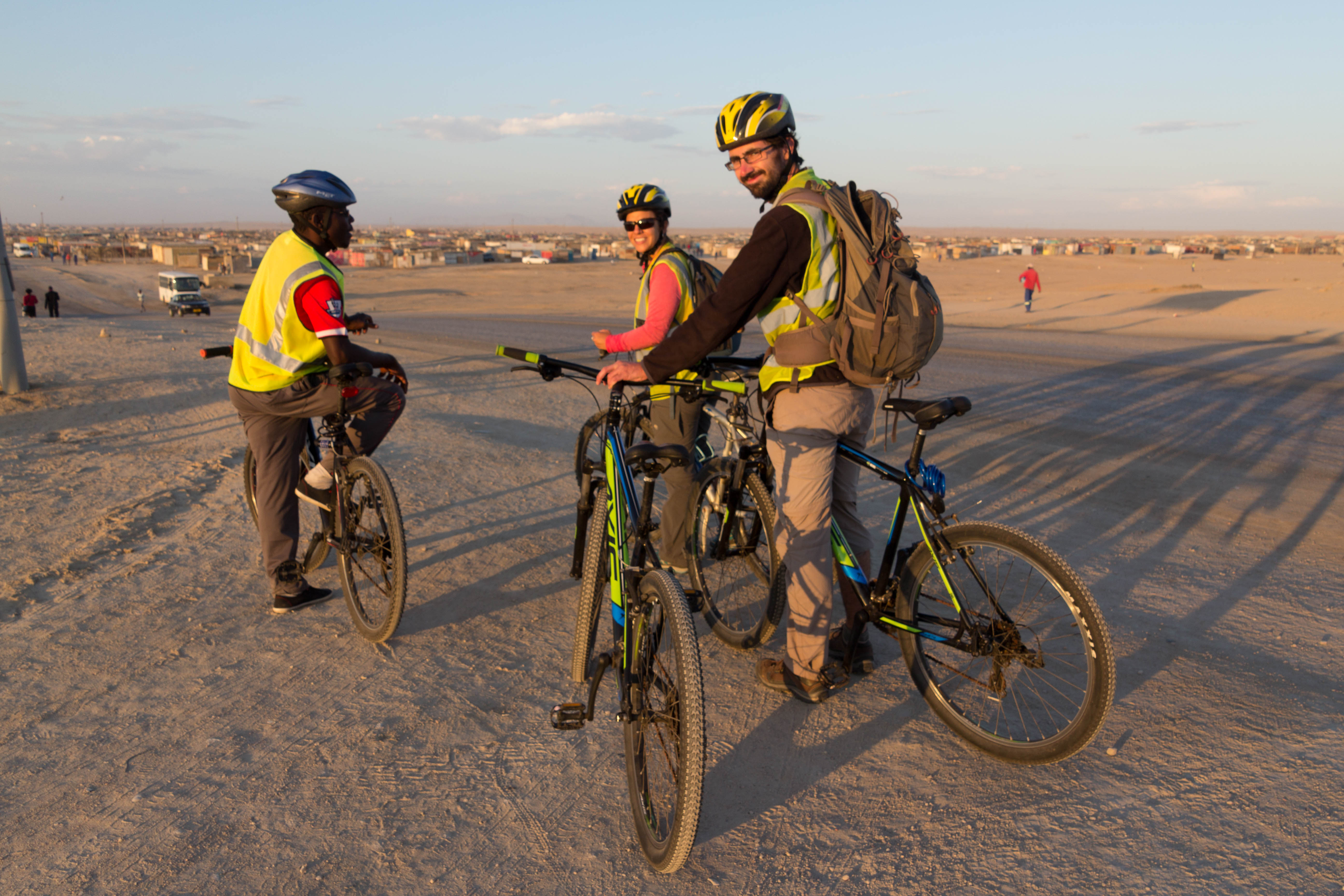
Of course most of the group were busy doing the adrenaline activities Swakopmund is touristically famous for: Skydiving, quad biking, sand boarding and the like.  I didn’t begrudge anyone enjoying these activities, of course, I just decided that I wanted to have a recuperative break here, and try to get to know the local communities a little better.  So, together with the Frenchies Sandrine and Benoit, I elected to go on a Township tour that could be done on bicycle.

It was a wonderful experience.

Getting out on our bike township tour

Getting out on our bike township tour

First of all, it was just great getting out on a bike for the first time and getting some needed exercise.  Our guide, Costa, was wonderful, generous, and enthusiastic about showing us the township which was also his home.  We made several stops enroute – to try biltong being sold by women on the side of the road (this is a type of dried meat like jerky but way better tasting) and next to a Herrero woman’s home.  She talked about what life was like here in the townships when the whites basically ousted all colored/black people to the outskirts of town – telling them that they would be provided better housing even though the purpose of the move was to establish segregation.  She said her family were given a much better concrete house compared to the converted rail carriage that they had been living in, so they were happy.

Township water pump

Township water pump

I learned that Herreros are essentially descendants of the Himba people.  The Himba were employed as servants and in general labor when the Germans first arrived here.  However, the German wives were none too pleased that their husbands were in the constant company of women who walked about without shame of their nakedness.  When these women started having babies that were far more light skinned than their husband’s genes would naturally procure, the wives insisted that the Himba employees clothe themselves modestly.  The Herrero chose very distinct clothing to ensure that their heritage would remain very distinctive, with giant headdresses that appeared like the bulls of a horn and would make the people look taller than they were.  Women of the Herrero were expected to marry young, and their husband would be chosen for them by their father’s brother.  Of course, as in many African cultures, men could have multiple wives, but it was interesting to hear this woman talk about how it was the first wife’s job to choose wife number two and three, making sure that they weren’t as pretty as wife number one.  For the lady whom we met, she thankfully said she’d raised seven children while being her husband’s only wife.  Enquiries as to why he hadn’t married more women were politely smiled at but not answered.

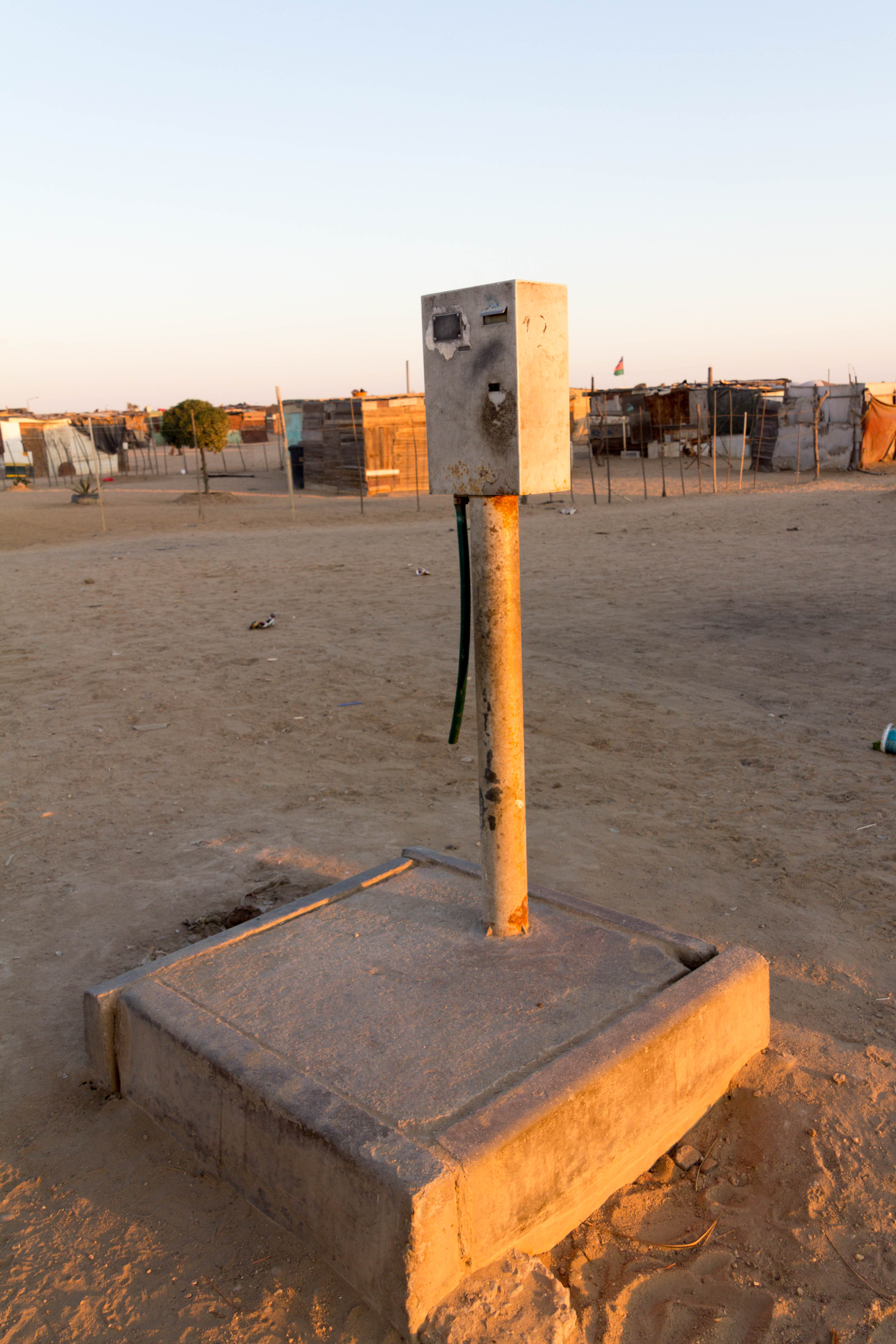
Cycling further into the outskirts of the townships we were able to observe the concrete permanent structures changing to tin, corrugated metals and makeshift cardboard and the dwellings went on as far as the eye could see.  Water is a precious resource in this township and it was interesting to see the line of people at the single pump for hundreds of residences, awaiting to pay money into a coin slot in order to fill up their jerry cans.  When you ran out of cash, you also ran out of water…

Me and a local Herrero woman

Me and a local Herrero woman

Our guide explained how you could qualify for help with certain types of housing with the Namibian government.  However, he also said that it wasn’t enough for you to have low wages; they had to be low enough to qualify, but high enough to afford the high interest rates on the mortgage.  He said he didn’t earn anywhere near enough to qualify, and was stuck sharing a small two bedroom unit with about 6 of his friends.

Closer look at the houses of the township

Closer look at the houses of the township

As the sun was setting we also visited a herbalist who was Tamara and kindly also gave us a great demonstration of the five clicks of her language while talking us through the various herbs and remedies that provided her livelihood.  It was so crazy to me that these people all lived together, all with such different backgrounds, cultures, each speaking their own native tongue but communicating with the majority either in English or Afrikaans.  We finished our tour with some streetside bbq which was delicious and then retired to a local bar where we were serenaded by an incredible 8 member a capella group who astonished me with their beautiful faces and harmonies.

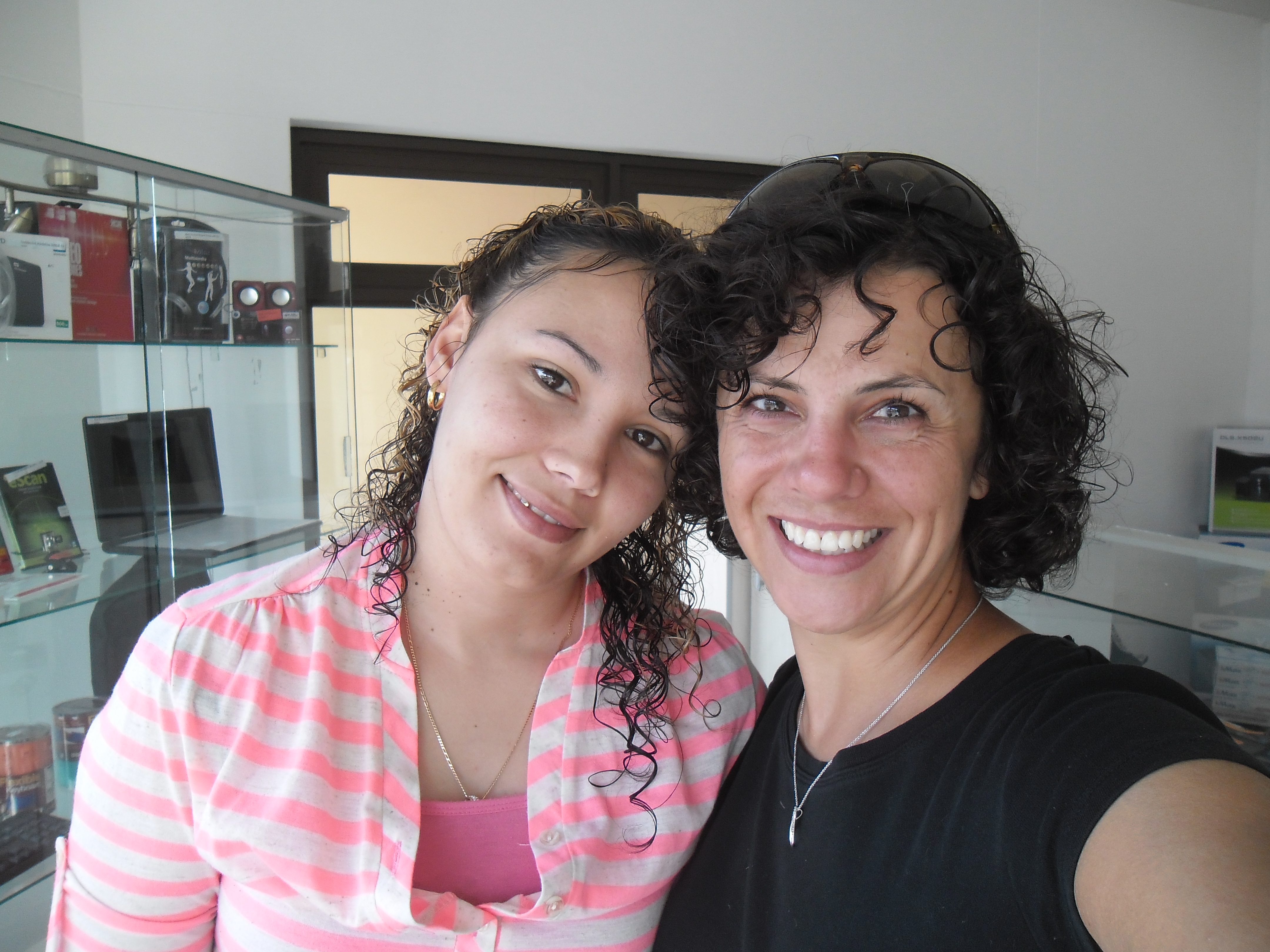
This was definitely one of the highlights of Swakopmund for me.  The other came quite strangely, again, from my computer dilemnas.  Attempting to find a cheap replacement laptop as well as a way to fix my camera, I met a woman called Marshall who worked at Royal Computers about 15 minutes walk from our hostel.  After talking to her several times about the various models she had for sale, and discovering that she could very kindly restore the over 2000 photos that had been accidentally formatted from my SD card at a dumb internet café, she offered to drive me around the city in search of a good laptop.  I couldn’t believe how kind she was, and after four or five stops, I found a decent Lenovo for just over $500 that would serve me well for the remainder of my trip, if not in life after.

Me and Marshall

Me and Marshall

She introduced me to her husband and son, and her co-worker Chri-Lei, and the small group of us hang out after the shop closed on a Saturday, chatting merrily about life and what my travels had been like thus far.  I invited everyone out to lunch, but unfortunately the family had an appointment to go to.  I sang Marshall a song after she requested one and choosing a Janis Joplin number, she welled up with tears as she reached to hug me goodbye when I finished. I was very moved.

Walking towards the beach in search of a deserved beer, Chris-Lei joined me and he and I ended up having several rounds of drinks over fish and chips at a great little beachside restaurant for the rest of the day.  We talked about philosophy, religion, race, life in America, life for him in Namibia; there wasn’t a topic that was off the table, and it was so completely refreshing to feel such a great connection to another person.  To feel that I mattered again, to someone if only for a few hours.

Me and Chris-Lei

Me and Chris-Lei

Returning to my hostel first to take care of some errands, we arranged to meet up later and catch a movie at the local cinema.  Despite being a horrendous American Avengers movie, the cultural experience of going to a film here in Namibia made it well worthwhile.  Popcorn was served only  half-full – the people applying all manner of different flavored toppings before handing it back and having it filled completely.  The movie theatre was packed small with people of every shade of color, all talking in multiple languages and often during the movie that had terrible sound quality.  I still enjoyed myself thoroughly, especially in my new found friendship with Chris-Lei who later walked me back to my hostel.

It had been a lovely and refreshing change of pace to stay here a while.  But it was time to head back out now into the southern desert.

Namibia – Cheetahs, Tribal Nakedness, and Extreme Temperatures

Tags

, , , , , ,

View over the northern Namibian desert

View over the northern Namibian desert

We were on the road staying in a different bush camp each night for several days following Etosha and preceding our stop in Swakopmund – a luxurious four days that we’d get to enjoy the luxury of a dorm bed.  What was fast becoming apparent in Namibia was the difficulty of maintaining bodily comfort due to the excessive swings in ambient temperature each day.  Mornings waking up huddled in my 15 degree F sleeping bag were cold, breath creating its own fog on exhalation.  They required long pants, and fleece layers as well as my wooly hat.  However, by 10am we were often sweltering in the heat of the sun, the temperature starting to soar and then bake us through to sunset when it would turn around and plummet once again.

I came up with an ingenious routine of dressing in layers that could be easily peeled away – so I’d wear my shorts under my long pants, and my tank top underneath a t-shirt and long sleeved shirt and fleece on top, knowing that I could peel the clothes and stow them comfortably in my day bag.

There were times, however, when even this wasn’t adequate – such as during our drive south once we’d hit the western coast of Namibia, known as the skeleton coast, presumably because of the number of ships that had wrecked here as well as the number of skeletons that amass on the shores of the massively populated seal colonies.  Apparently, this area gets a lot of its wind currents from Antarctica, and on two separate days, the cold was so bitter that it sent all of us diving into our lockers to extract our sleeping bags which we proceeded to climb into, fully clothed, even as we sat on our chairs huddled together for collective warmth.

Stroking one of the "pet" cheetahs...not that I approved of the place

Stroking one of the “pet” cheetahs…not that I approved of the place

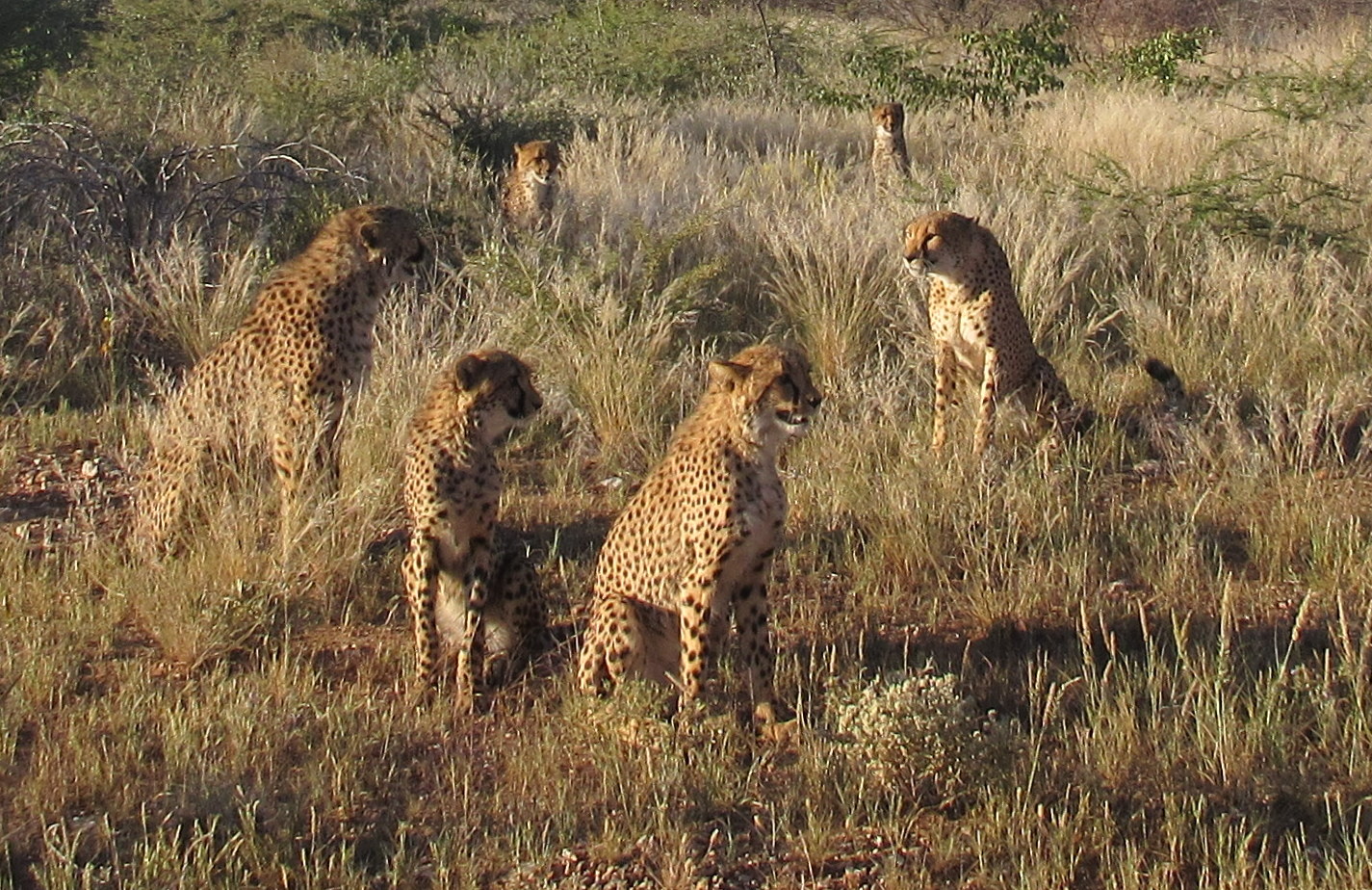
Namibia is covered with desert landscapes, but also incredibly beautiful rock formations, sand dunes, and miles and miles of beautiful sandy beaches.  Our first stop after leaving Etosha National Park was the Petrified forest park where we endured blistering sun and temperatures for a thankfully short walk to view the petrified logs.  Later we were taken to a rather strange and somewhat disturbing “Cheetah Park” where the white Namibian owners had 3 cheetahs kept in a domestic capacity as pets, together with a group of “fenced in” cheetahs that they fed daily as part of their artificial cheetah safari.  Enquiring as to how they came to have cheetahs on their farm, the owner told a rather disturbing story, but didn’t seem to have any ethical issues with it himself.  He basically explained that cheetahs had been attacking and eating his cows, and that he’d taken to shooting them (around 10-15 years ago) but then one time, decided that he’d catch them instead using a trap.  After successfully trapping one female cheetah, it turned out she was pregnant, and so he decided to take the cubs away from their mother and keep them as pets, and later charge people to come to his home and have pictures taken with his cuddly friends.  Of course, he used slightly different verbiage – but this was the gist of it.

Creepy, right?


Pretty Cheetah

Pretty Cheetah

What made the place even more suspect was that we were later driven around what was essentially a penned in area of land where we observed maybe twenty cheetahs all waiting to be fed by the chunks of meat the driver would heave into the air.  Some of the cheetahs looked a little sickly, like they’d been physically harassed by the other cheetahs, and besides my obvious concern over their well being in this regard, I couldn’t shake the feeling that cheetahs really should be roaming free, hunting, and catching their own food.


Cheetahs, cheetahs, everywhere...but waiting to be fed?  please....

Cheetahs, cheetahs, everywhere…but waiting to be fed? please….

Hoping for a more authentic experience than the Cheetah park, we headed the next morning on a visit of a Himba tribal  village.  Many of the Himba people living in rural Namibia still live with their traditions and customs that are unavoidably startling and somewhat uncomfortable for us westerners to observe – especially when it is presented in this fashion of “come to our village and see our naked women, our huts, and our children presented to you as if they are exhibits in a museum.”  Except the exhibits are alive and you feel as though you’re violating their rights to privacy taking photos (which they encouraged us to) as if they’re lions in a game reserve.  Ultimately, however, the culture of the Himba people is so foreign and fascinating, that one feels compelled to go and see for oneself, and one can’t help but take photos and swallow the given discomfort that accompanies the experience.


Himba woman and her son - I love the village meets western clothing in this pic (see the baby's shoes)

Himba woman and her son – I love the village meets western clothing in this pic (see the baby’s shoes)

Young men of the Himba tribe have their three front lower teeth knocked out by their fathers when they are young teenagers.  We were informed that this both distinguishes their tribal roots and also aids in the pronunciation of their dialect.  Women are mostly naked, dressed in little more than leather strap-like skirts and elaborate beadwork about their necks and chest.  Most notable, however, is the habit of the women not to bathe – at all.  Instead, they keep “clean” through a combination of spreading Okra-based paint onto their skin (which gives them their rich rust-orange like color) and sitting in the huts and “smoking” themselves – which is exactly what it sounds like: sitting in an oxygen deprived hut directly in front of a fire and letting the smoke cleanse your body (though exactly how this happens I’m not sure.)

The men, apparently, wash as we do with soap and water.  Of course, I felt a natural revulsion for their sanitary practices, and I recognize how ethnocentric that stance is, but I’m ok with it.  Making it even more difficult to believe – the women also put copious amounts of okra onto their hair, creating these elaborate headdresses out of their own tresses that they then embellish at the ends with circular mounds of animal fur.

The seal colony on the Skeleton Coast

The seal colony on the Skeleton Coast

I found myself aching to ask how/what the women used during their menstrual cycles and whether they could use water during this time for their ablutions.  I was left, unfortunately, to wonder.

This visit had been a highlight for Andy, a beloved member of our group, who was also celebrating his 46th birthday on the same day.  There were the obvious jokes about getting to see naked women on his birthday.  Since we were facing a very long drive to our bush camp that evening, we all decided to stock up on some booze to go along with the game bbq dinner Tabitha had promised to make us that evening, as a treat.  Around 2pm in the afternoon, someone suggested we crack open the alcohol stash and make a party of the afternoon’s drive, and that was it.

Truck Party time.

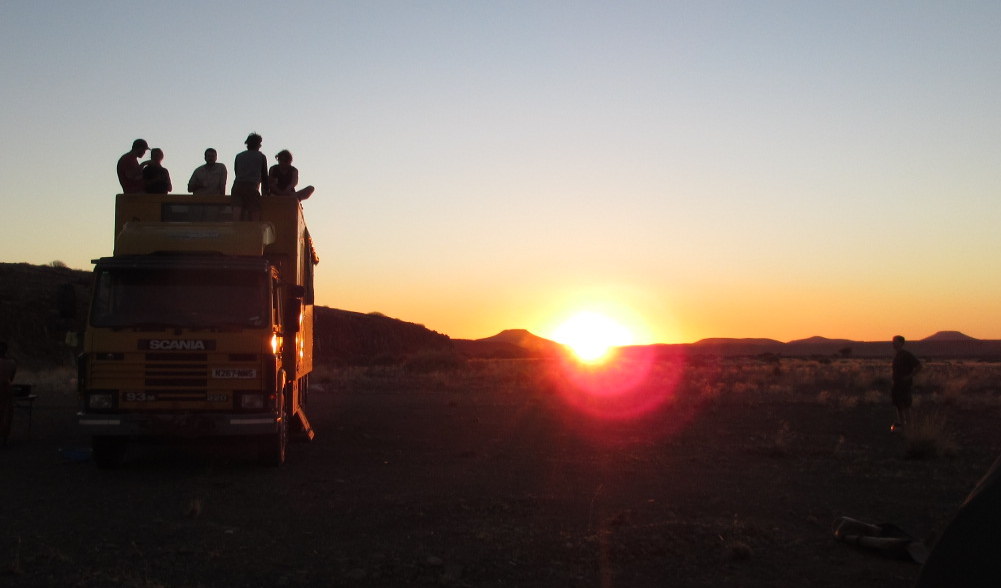
Sunset and partying on the roof of our truck in our Bush Camp

Sunset and partying on the roof of our truck in our Bush Camp

Andy put on a rocking compilation of music and we were all soon singing along and dancing up and down the central walkway of the truck.  We just about managed to get out of the truck and scramble to dizzying high viewpoints as the truck stopped at scenic photo opps along the way, though the climbs got progressively more difficult the more libations we imbibed.

By the time we got to the absolutely stunning setting for our bush camp, it was already time for sunset and most of us were winding down from our “night” of drinking.  The meal that night was the most memorable of the whole trip – we ate Oryx or Gemsbok and it was quite possibly the most delicious meat I’ve ever put in my mouth.

By 8 o clock, Andy had collapsed asleep in his tent, so any further party plans were soon squished besides the few of us who decided to make a night of sleeping directly under the stars sans our tents.

Nicely recovered from what had been a “day of revelry” – we happily set off towards the skeleton coast, first re-tracing our route a few miles as two members of the group had lost articles of clothing and hats during the dancing and truck party the afternoon prior.  Half successful, we turned about and headed towards the aforementioned block of cold air that hit us a few hours later, promptly finding us inside our sleeping bags in due course.  We had a number of strange stops that day before our perhaps even more strange stop that night at our camp (that had showers!!) at Hettie’s Bay.  We visited an abandoned oil mining shaft in the desert, a shipwreck on the beach, several more cliff top view points, and most surprising of all – Cape Cross Seal Colony.

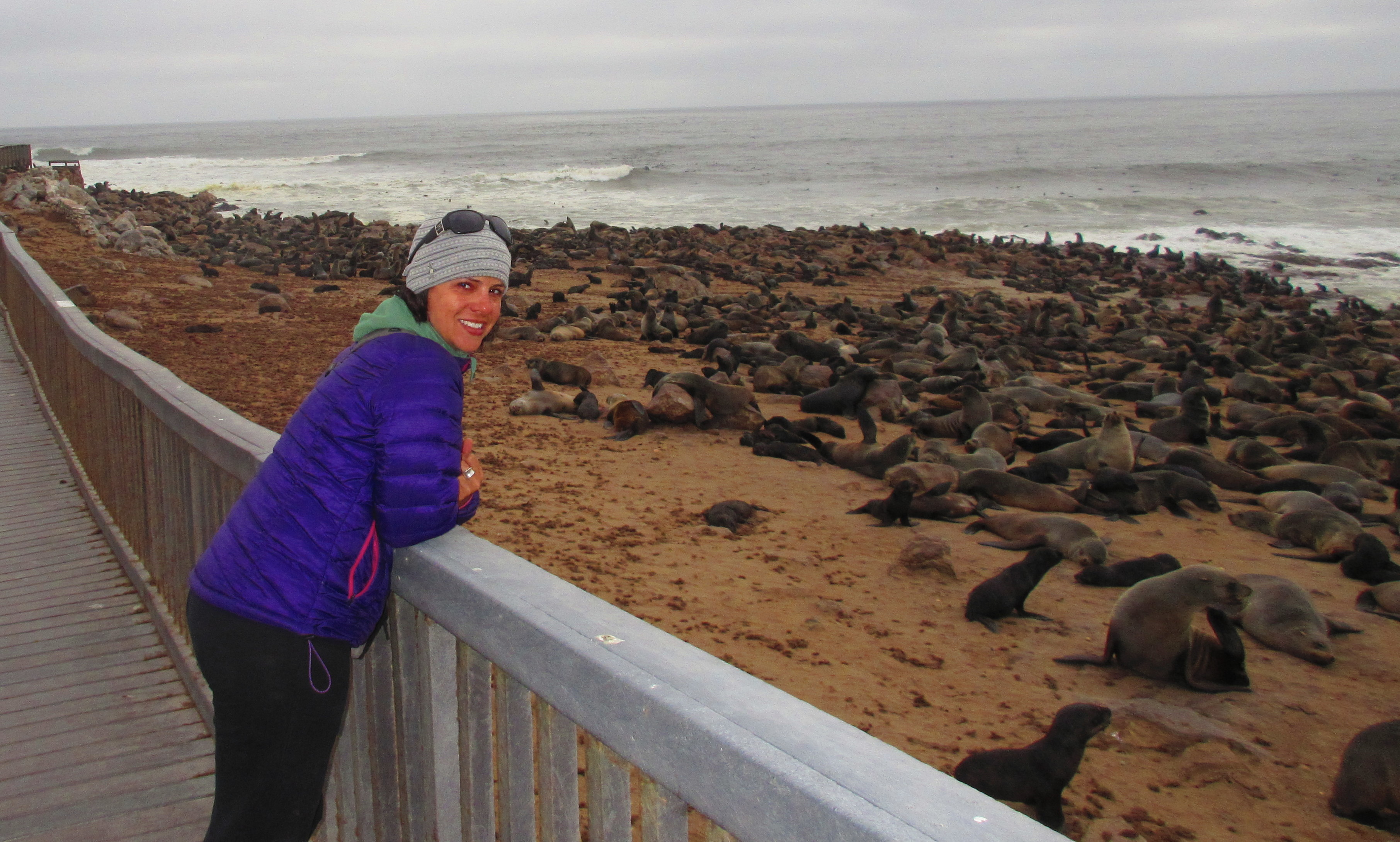
Never have I seen this many seals in one place.  It made the Galapagos look like a quiet vacation spot for seals by comparison.  There were literally thousands of them crowded on the beach as far as the eye could see, lots and lots of young pups all screeching for their mothers amongst the masses.  If you looked carefully, you could also spot lots of pups that hadn’t survived and their remaining skeletons littering the beach too.  Reading the interpretive signs that were on display, we were disturbed to read that during the summer months when the pups are born, thousands can perish on a given day if the wind dies down for an extended period of hours – offering no relief from the relentless heat that they are just too weak to survive.

Desert

Desert

The temperature dropped even further as we arrived in Hettie’s Bay – a very very strange and somewhat creepily deserted town that was home for the night.  As it was the birthday of another member of our group, I made my best effort to go out for a drink after dinner – and found myself in a pub that somewhat resembled one of the nasty run down pubs they have in Everett along the Aurora highway.  Except with really bad Afrikaans music playing.

Weird.

I was very happy to arrive in Swakopmund the next day, and the weird Germanness of the town was overlooked, for now, because of the prospect of sheets and a bed for the next re-humanizing four days.

Etosha National Park – Moonwalking Rhinos and Cheeky Honey Badgers

Tags

,

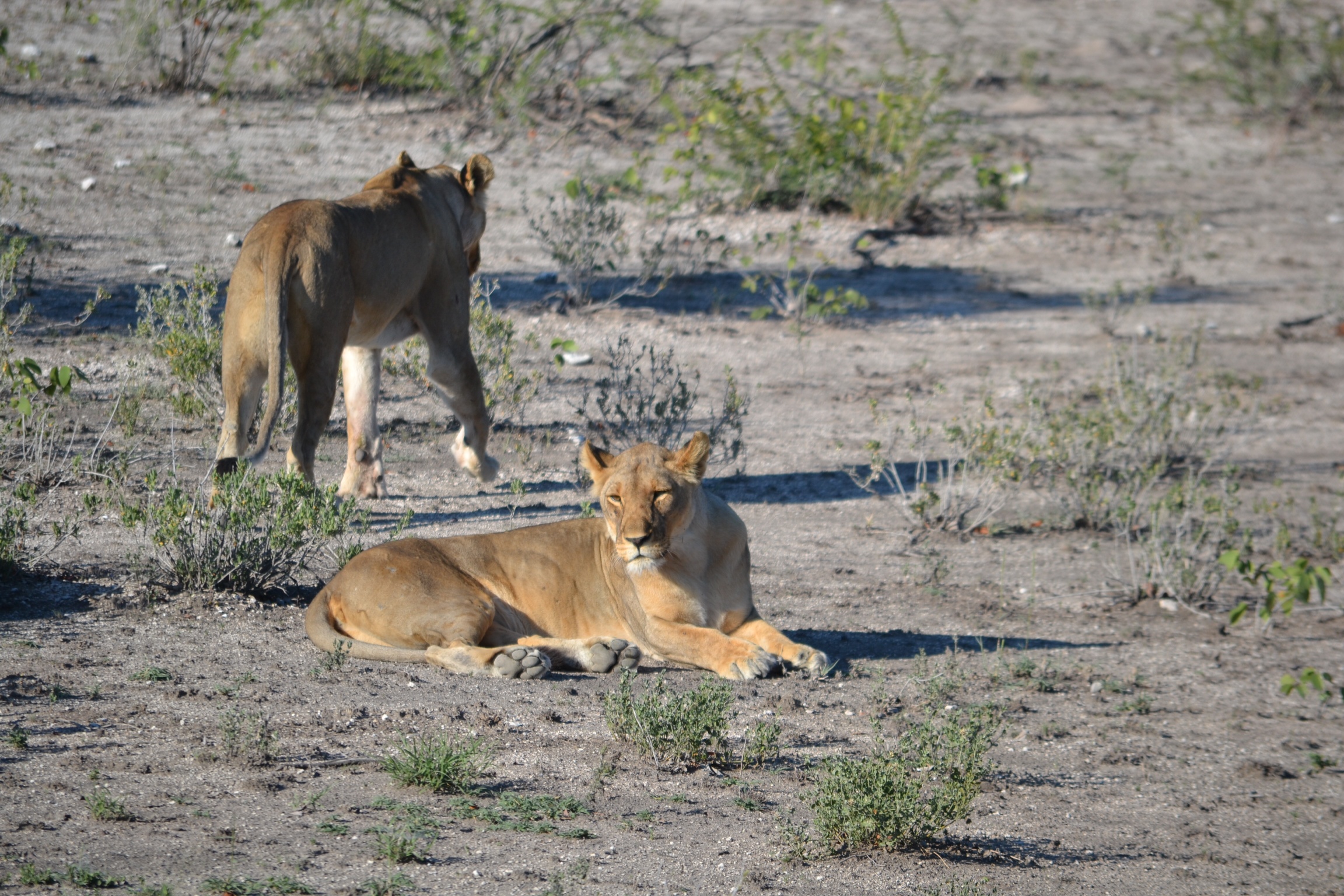
Lions at Etosha

Lions at Etosha

Our first big stop in Namibia was the large game reserve of Etosha National Park.  After a long drive in the morning, in blistering heat, our driver Pete told us that he was going to arrange for us to get private vehicle game drives as he was suffering with food poisoning.  After setting up our tents, we piled into two 4 x 4 vehicles for our 3 hour game drive.  We were informed that many of the animals had already moved to the western part of the park in search of water after the recent rains…a bit disappointing to hear as we first headed out.  Regardless, we were able to spot Eland, Hartebeest, Zebra, Giraffe, and Elephants during the drive.  We also had fun taking perspective pictures on the salt flats in the middle of the park.

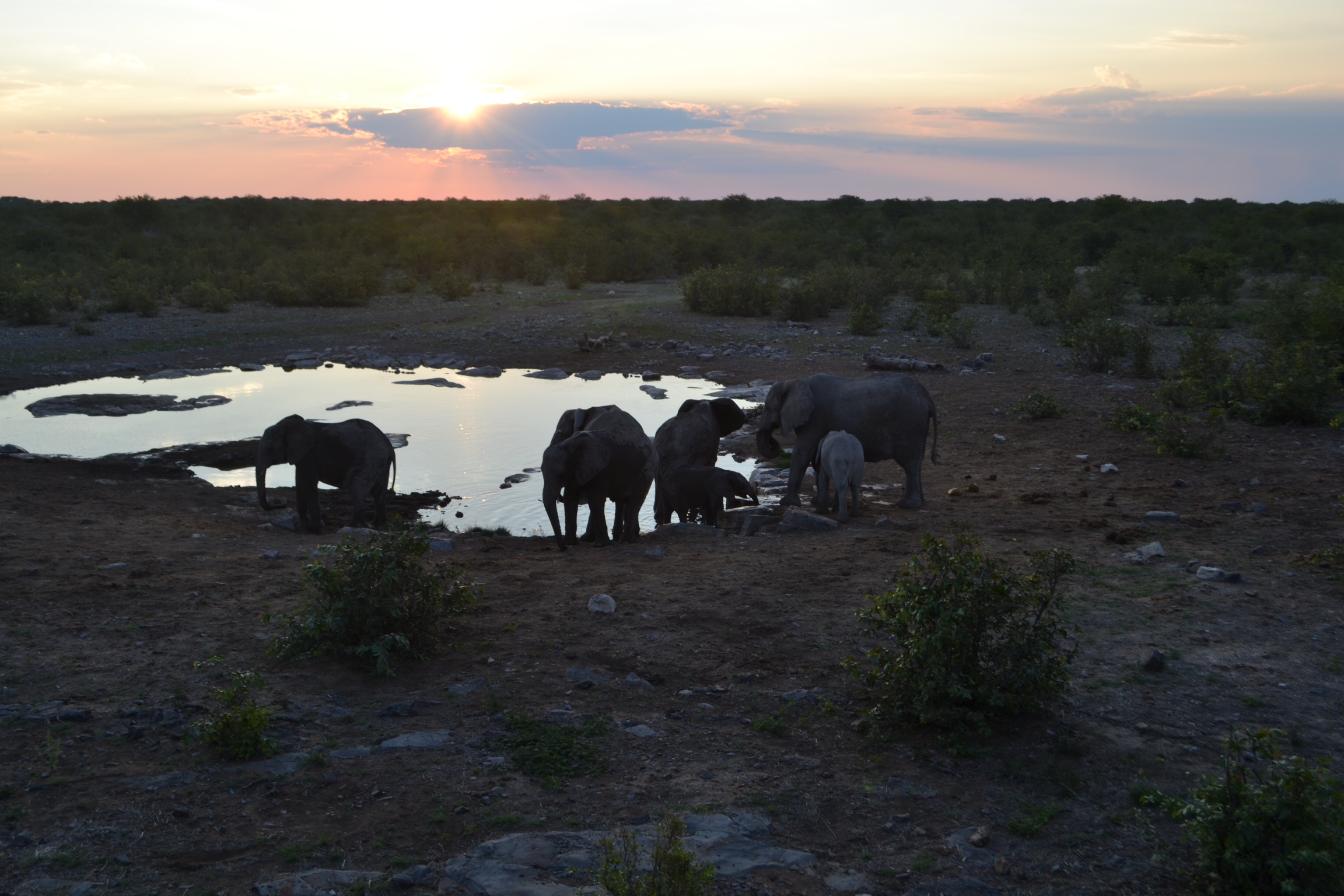
The absolute highlight of this place, however, came a little later in the day and was completely unexpected.  We had been told, in passing (as if it were really a minor detail) that there was a watering hole that we could go to after dinner, and if we were lucky, we’d be able to observe animals coming to drink throughout the evening and night.  However, as a few of us were readying ourselves to take a dip in the pool, a woman came by and casually said “oh!  There’s Elephants in the watering hole at the moment…!”

Hartebeest

Hartebeest

Since I was already in my swimsuit, I decided to take a quick swim first and then headed down to the watering hole.  I wasn’t really sure where I was going, but a set of signs quickly pointed me in the right direction.  At first, I felt a stab of disappointment as my friends, Sandrine and Benoit, informed me that the entire family of elephants, who had been playing in the water had now left.

My heart sank, but I sat down on a comfortable rock and enjoyed the view as the sun began to do the same.

Heading into Etosha, watching for wildlife from the Beach on the truck

Heading into Etosha, watching for wildlife from the Beach on the truck

And then, just as everything had grown extremely quiet, a black rhino ambled up to the water’s edge and began to drink.  It was incredible, being this close to the Rhino, and seeing him in such an unobscured fashion.  It was a beautiful scene and my heart was filled with gratitude.

Then, as we were getting ready to head back and shower in time for dinner, another rhino appeared from the bush and approached the watering hole!  Black rhinos are solitary animals, so it is extremely rare to spot two of them in one place.  These two rhinos were clearly male rivals, each asserting his authority over the space with audible grunts and aggressive posturing of his horn.

As time went on, things got even crazier, and Sandrine and I began clutching each other in excitement, unable to comprehend the rare spectacle we were being treated to.  The two rhino began to actually fight, one charging the other, and the other backing up in a move that strangely and hysterically reminded me of Michael Jackson’s moonwalk.  Then, another two rhinos appeared from the bush, chasing each other in a huge cloud of dust, dispersing the two that were already at the watering hole with a very audible display of upset at the intrusion.  Then, a hyena appeared, seemingly unconcerned by the rhino situation ensuing, and calmly drank at the water’s edge.

Elephants at the Watering Hole (someone else's pic!)

Elephants at the Watering Hole (someone else’s pic!)

For another hour or so, these four rhino came and drank at the hole, fought with one another, scratched themselves on a tree trunk, and stalked one another back into the bush.  It was a display of wills, strength and, well, high-stakes drama.

It made me realize something very important.  Each day we’d been on a safari, or visiting a place in Africa where we were on the lookout for wild animals, our guides would ask us, “what animals are you hoping to spot today?”  I always found this question bemusing, and usually resorted to the response that I’d like to see one of the rarer cats, a leopard, say.  However, this experience made me realize that on a safari, it’s not what animals you spot that make the trip memorable, it’s whether the animals are exhibiting interesting behavior while you happen to be observing them.

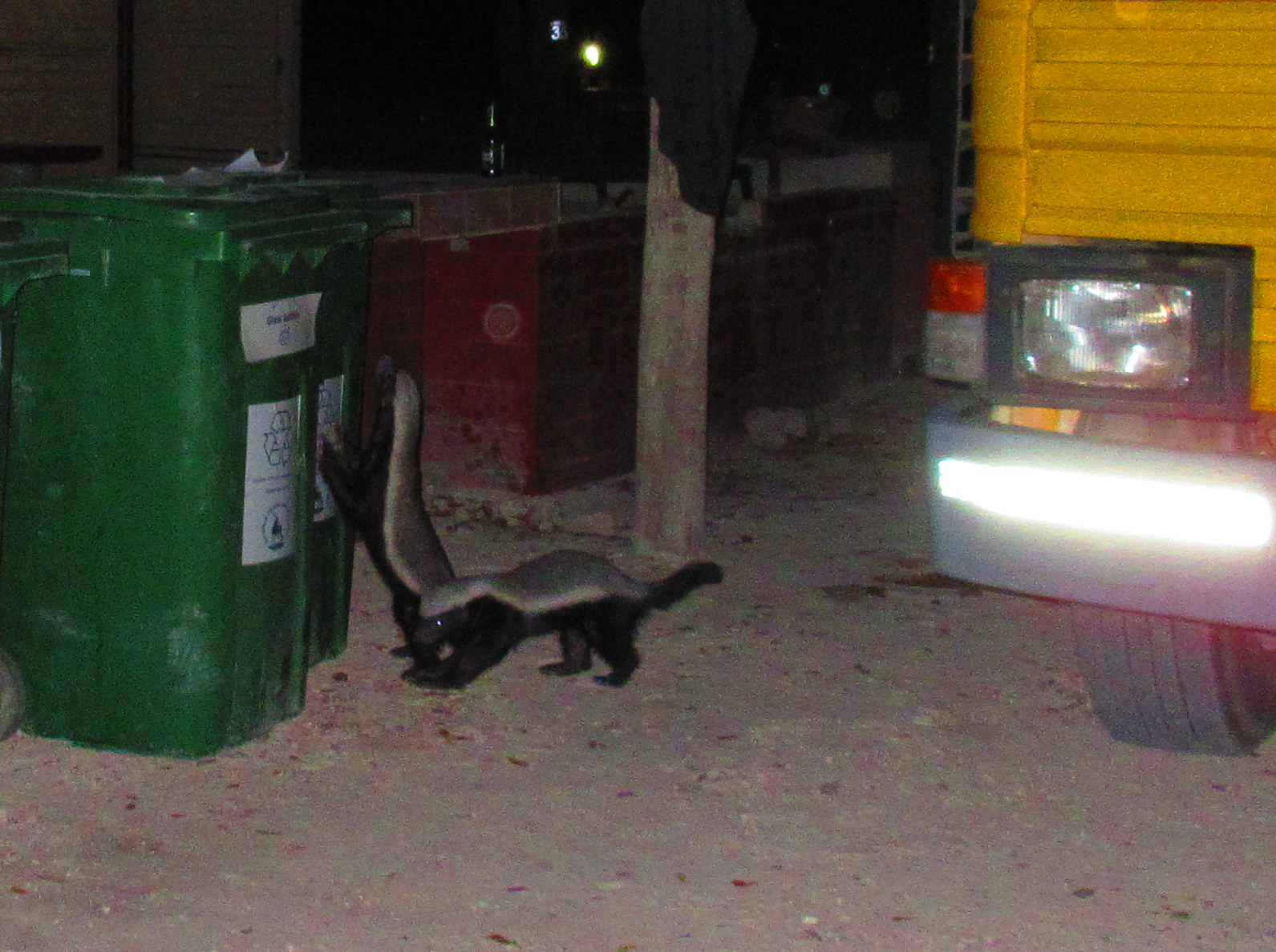
Cheeky Honey Badgers right before they upturned the trash cans

Cheeky Honey Badgers right before they upturned the trash cans

What kind of animal they are is of less importance.

It is very rare to see rhino.  It is even rarer to see more than one black rhino in one place, and astonishingly rare to have seen them fighting/interacting/vocalizing the way the small group of us did that evening.  I was humbled by the experience, and to that point – it became the highlight of the entire trip.

We also had one other treat in store.  The Honey Badger is a creature endemic to this region, and are known for coming into the campgrounds of Etosha and wreaking havoc, eating food out of tents, etc.  After dinner, as I was getting ready to return to the watering hole, I watched as two honey badgers came into camp and started attacking some towels that people had hung out to dry.  They are aggressive little buggers, with razor sharp teeth, and our guide had told us that they have been known to attack a lion, and humans.  I stayed a little back, and watched them as they also proceeded to tip over 3 of our garbage cans and make a complete mess of our campsite.

Taking silly perspective photos during our game drive

Taking silly perspective photos during our game drive

Returning to the watering hole after dinner(Sandrine and I stayed there until about 11:30pm)  we only got to see a single rhino, and a single hyena return – things were altogether much quieter and no way near as dramatic as at sunset.

Etosha was a very special place.

Okavango Delta – Botswana Unplugged

Tags

, ,

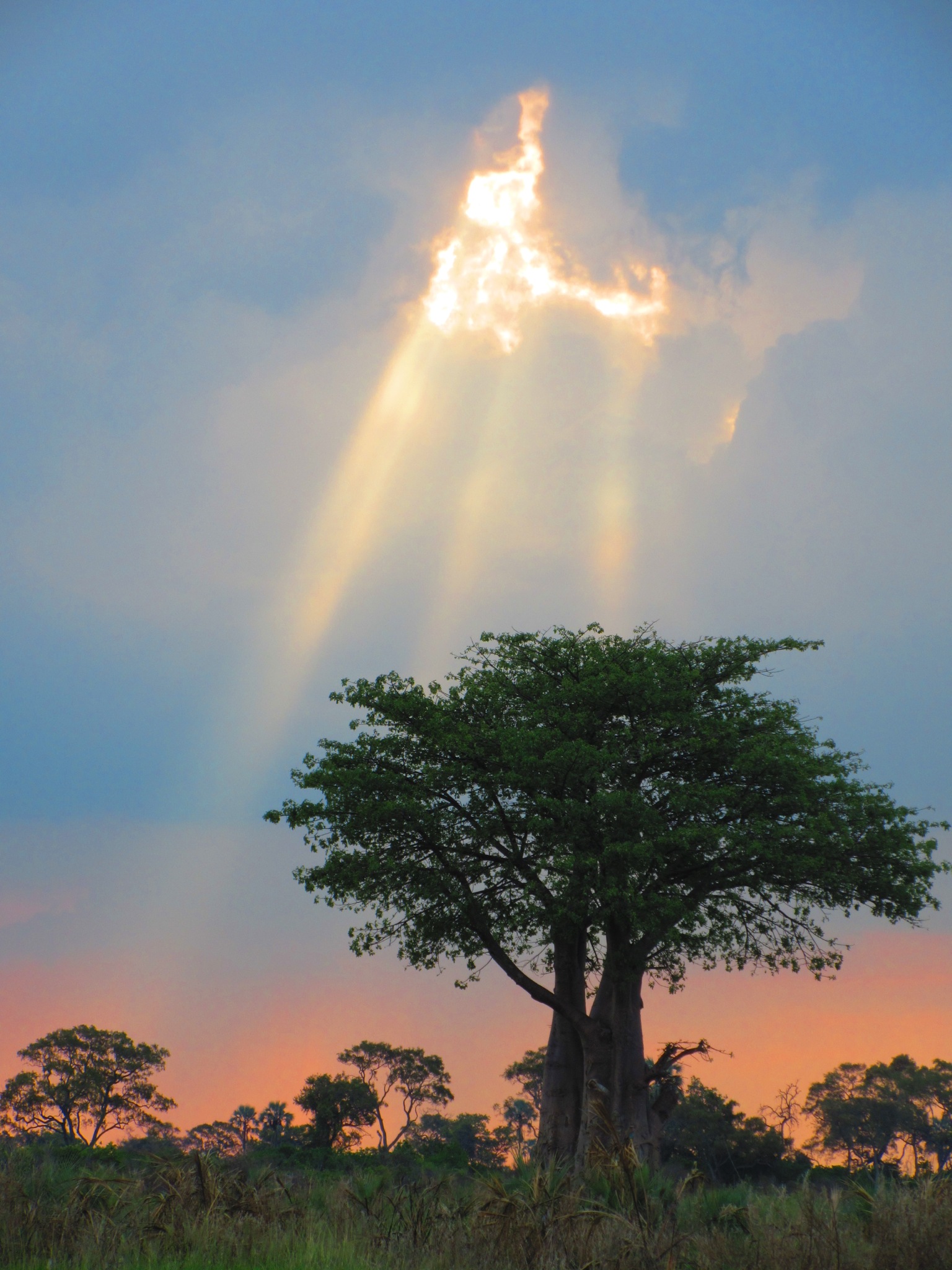
Sunset on the Delta

Sunset on the Delta

Arriving in Maun, we didn’t have much time to chill before we had to pack up for our 3 day/2night mini “break within a break” trip to the Okavango Delta.  The Delta is an huge expanse of land in Northern Botswana that is covered with fresh water that flows south from Angola, with huge areas of rivers and islands teeming with wildlife scattered throughout the region.

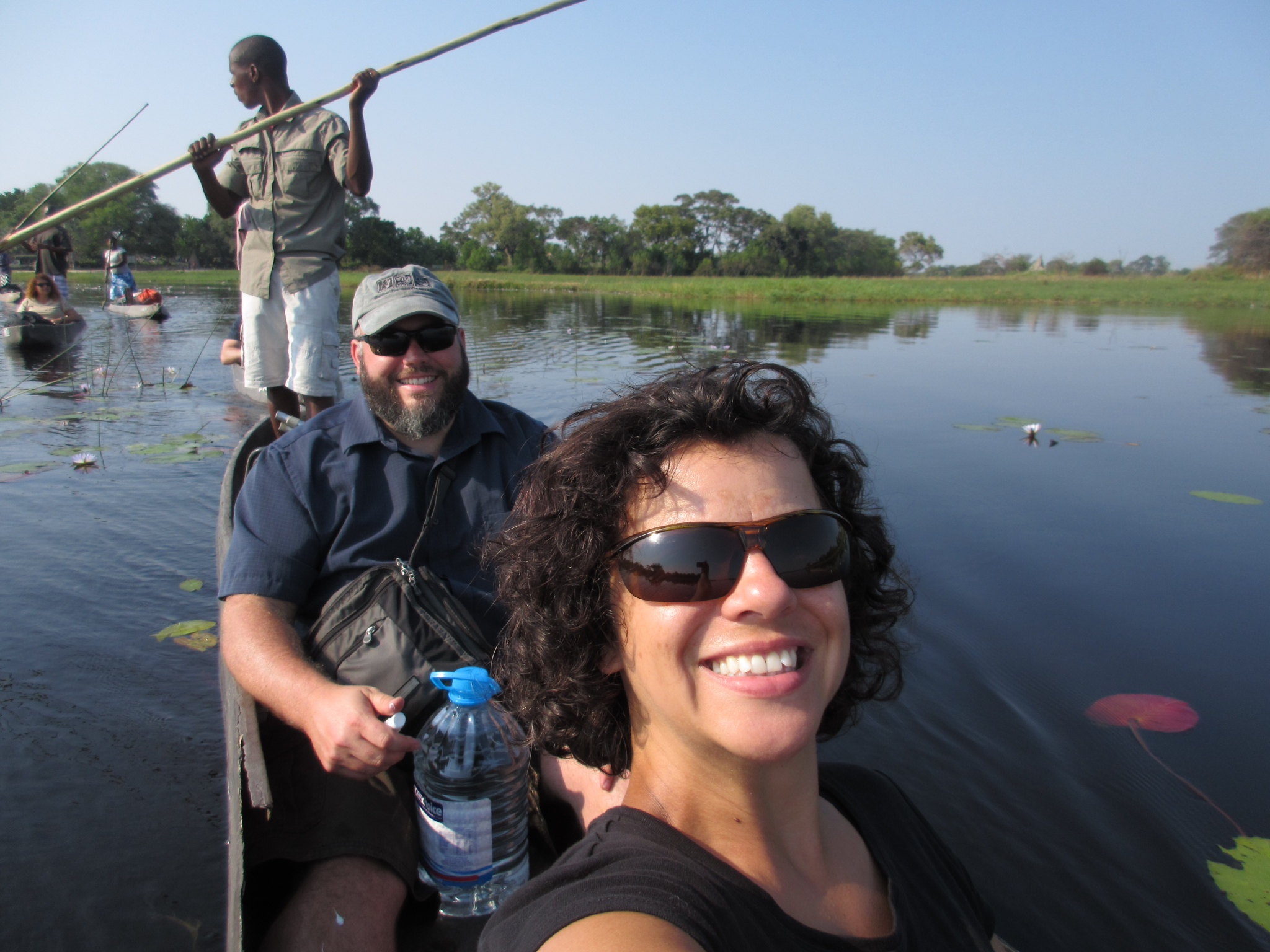
I was looking forward to having a smaller group dynamic as it turned out that only about 1/2 of the group wanted to go, the rest elected to stay in the campsite in Maun.  This was going to be very basic camping with no facilities, no electricity, no cooking facilities beyond a fire we made ourselves.  To get to the island where we’d be rough camping involved a very attractive aspect of the trip – sitting back in a Mokoro – a traditional wooden (now made primarily from synthetic materials) canoe that sits very low on the water and can be “driven” with a long wooden pole that is reminiscent of the methods used by gondoliers in Venice.

Cooking at our campfire

Cooking at our campfire

We drove about an half hour outside of Maun to a tiny rural village, where we were met by our Mokoro paddlers and camping “crew” and helped load the canoes with our equipment, food, and water for the stay.

The canoe ride out to the island lasted around two hours and was an almost hypnotically relaxing experience.  Just being able to lay back in the sun with legs outstretched and just watch the water glide by, covered in giant Lilly pads with frogs croaking and crickets chirping the only noise that broke the haunting silence.  It was lovely.

Heading downstream in the Mokoro

Heading downstream in the Mokoro

Upon arrival, we were told that our itinerary during our stay would involve early morning game “walks” where we would head into the interior of the island and try to spot Elephant, Zebra, Antelope, Wildebeest, and if we were very lucky, a big cat (though I wasn’t too sure how excited I would feel if I saw a lion wandering around when I was on foot) while the middle of the day would be taken as a giant siesta due to the extreme heat and humidity making it difficult to do anything active.

It was a very peaceful and refreshing two days spent in the Delta.  Without much to “do” when resting in camp, we were able to slow down our pace completely and fill the time with conversation in the group, playing games, reading, napping, and taking a swim in the “hopefully – “wait! What was that noise?!!” non-crocodile infested waters.  We even played a great game that relied heavily on charade-like skills and it was thoroughly enjoyed by all.

Safari on foot - sometimes crossing to different islands

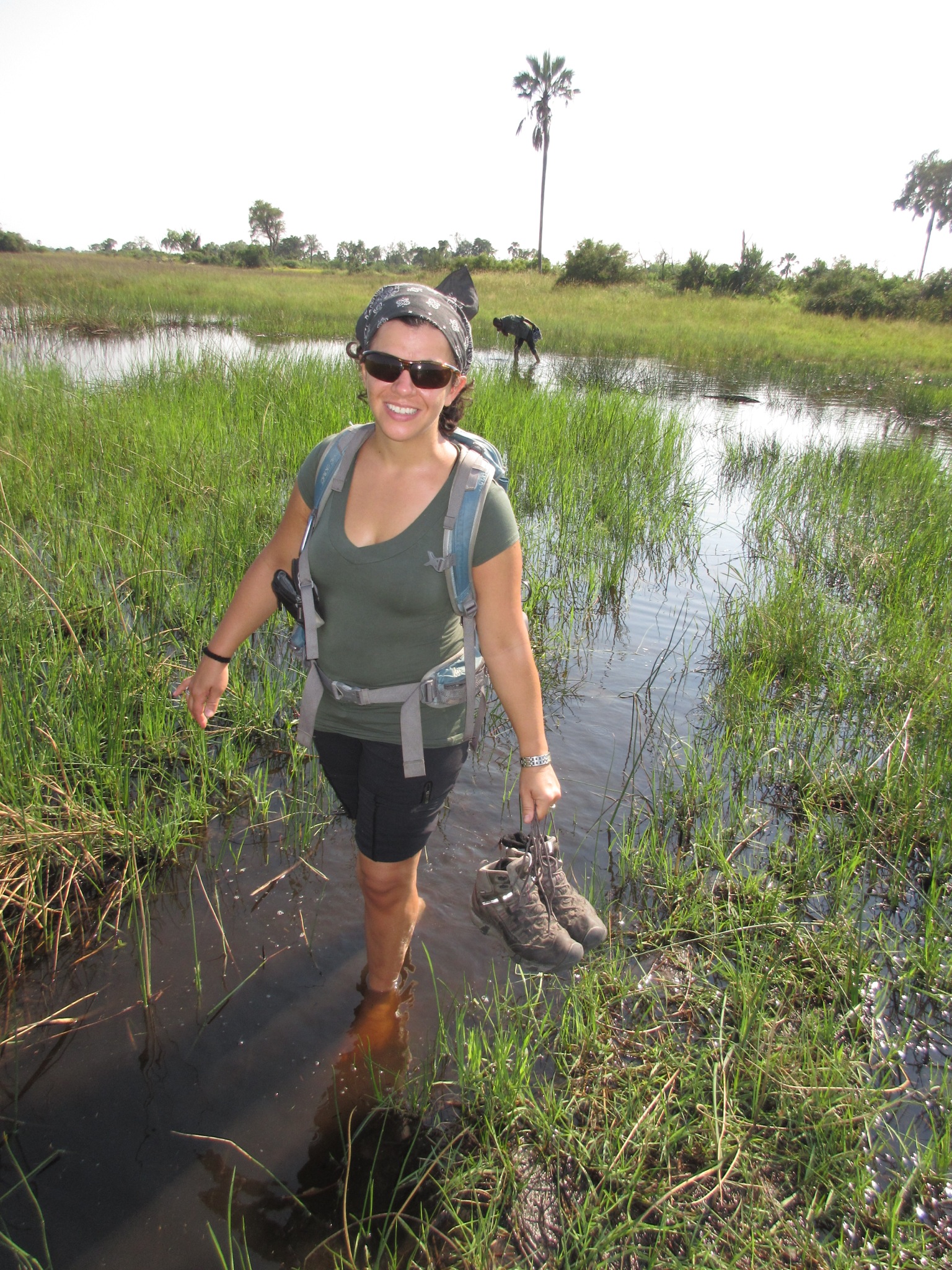
Safari on foot – sometimes crossing to different islands

The highlight for me was the late evenings.  We would cook our meals as a large group and eat all around our communal campfire.  Then we’d go out to the riverside and just bask in the glory of the un-illuminated night sky that shone brilliantly with thousands of stars, while simultaneously watching the flashing sparks of the lightning bugs that lit up the air nearer the ground with their glow.  Though difficult at times, we also tried to listen…intently listen – to the beautiful silence that accompanied the hum of the crickets (which Andy humorously dubbed to sound like clanking beer bottles) in the night sky.

Every now and then, the sounds of the crickets were poignantly interrupted with the low groans of the hippos standing nearby, or the laugh of a hyena.  It was eerie, and a little hair-raising, but deliciously exciting and adventuresome at the same time.

Froggy

Froggy

We walked for miles on our game walks and did manage to spot several different kinds of wildlife – elephants, zebra, wildebeest and giraffe among them.  Our guides were enthusiastic to explain anything we might want to know about the delta and how to keep safe when walking so close to these amazing creatures.  We were warned of the false charges that the elephants can make – exhorted to stand our ground, and not run, should one of them decide to.

On the last night, our crew entertained us with local songs and dances around the fire.  Then we played a nerve wracking game called ‘Chief” which by a process of elimination left only the quickest witted amongst us still standing at the conclusion.

Sun setting...

Sun setting…

By the time it was time to turn the mokoros around and head back to Maun, I felt like a more wound-down version of myself and like I’d formed a closer bond with the individuals who decided to come along.  We hadn’t partied, hadn’t sang music loudly till the wee hours of the morning, but we’d thoroughly appreciated the rest, return to nature, and peace that the Delta provided to us.

On arrival back in Maun, we were very grateful to have an hour or so to re-humanize with a shower, and try to check some email, though this turned out to be an exercise merely in frustration.  We were bush camping that evening as we headed out of Botswana in the direction of the Namibian border – which we would cross the following morning, which also just happened to be my birthday.

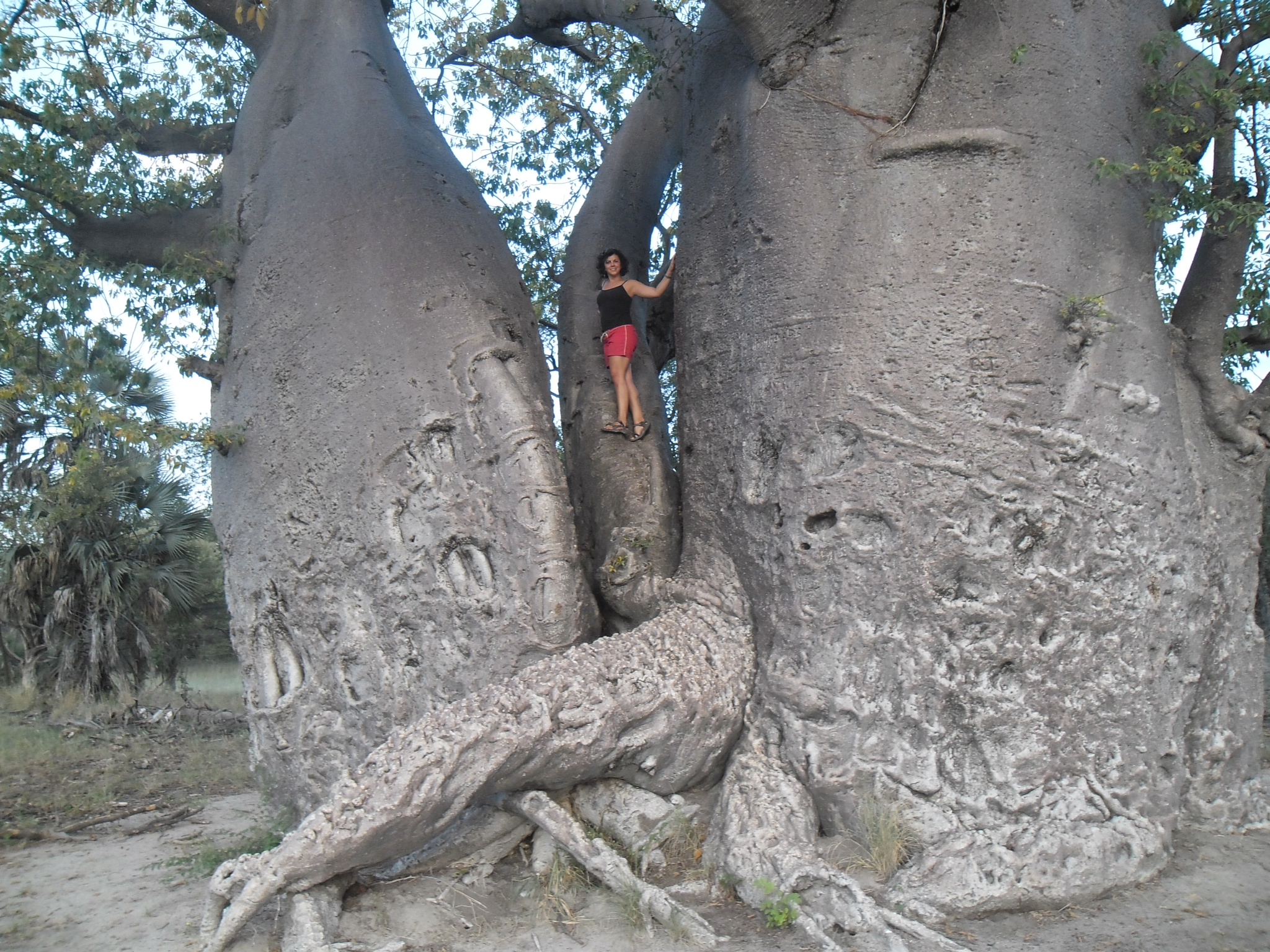
Climbing the Baobab Tree

Climbing the Baobab Tree

It’s not every birthday that you get to go to Namibia.  But I did.  Funnily enough, on a 56 day trip, it was only on my birthday that I overslept by accident – Maud’s alarm clock failing to wake us up in time for our 6am departure.  We still managed to eat, pack, take down the tent, and use the “facilities” (a hole that you had to dig with a shovel) in under 20 minutes!  The border crossing passed without any more incident than the final foot & mouth disease shoe-washing checkpoint – and two customs’ officers who failed to notice that it was my birthday upon stamping my passport.

It was a long drive day – but we were lucky enough to stop at a supermarket where I decided to buy ice and lots of goodies for myself to enjoy later that night in bush camp #2 – and technically, the 4th night of bush camping in a row.  I ate a donut and got myself custard to have as dessert after dinner.

Birthday celebrations

Birthday celebrations

...and Cake

…and Cake

Our campsite that evening was also unique in that it contained the largest Baobab tree in Namibia.  These trees are significant in that they look like they are “upside down” – meaning their branches appear as if they are, in fact, roots instead.  We had fun taking pics climbing the massive tree as the sun set.

Later, after dinner, we drank and danced to music – and I even sang a song for the group.  I got a birthday cake replete with candles that struggled to stay alight – but all in all – it was a lovely birthday celebration and I was grateful to have it here in the African bush.

It was, as it turned out, entirely ironic that when the party was finally getting going, around 10pm, we were sent to bed after a small scuffle broke out between two of the lads.  One of the few nights that I was in the mood to stay up drinking and dancing…and alas, it was not to be.  Funny how that works out, eh?

Elephants, Slow Fast Food and Soggy Tents

Tags

, ,

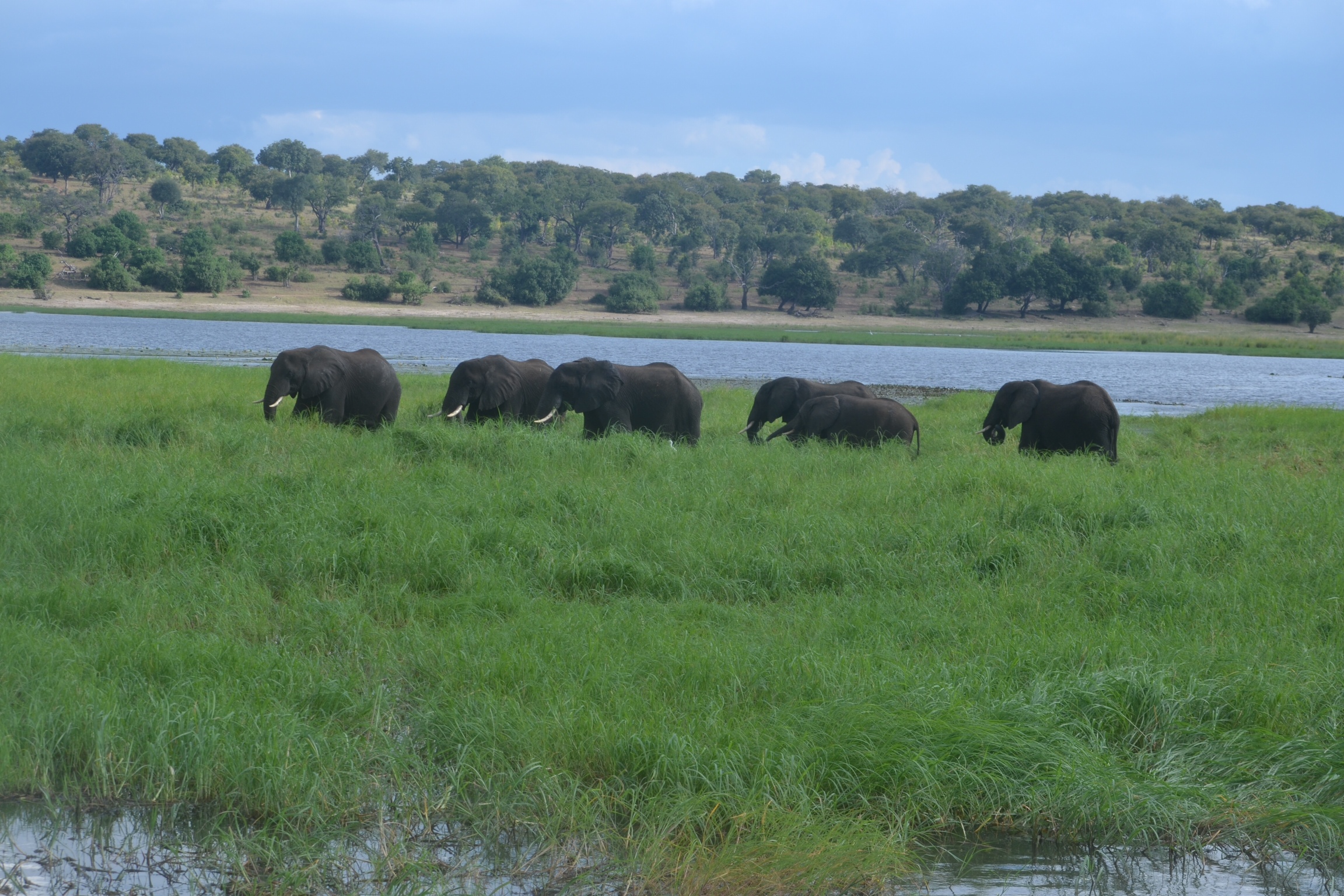
Elephants in Chobe

Elephants in Chobe

Vic Falls being our last stop in Zimbabwe, we headed off in the direction of our next stop, Chobe National Park in Botswana, close to the Angolan border. As usual, it was with mixed feelings that we acquiesced to returning to the truck, especially now that space for stretching out was in shorter supply, so when we pulled over for a late morning stop at Wimpy (which I haven’t eaten at since I was a small child and it was a hamburger chain in the UK) we were rallied by the prospect of fast food and free wifi (our group descends on free wifi like vultures on a carcass.)

However, this was not going to be a fast experience, and one member of my table was asked to show his receipt for a cheeseburger and coke a total of five times before he was served his food. It turned out to be quite entertaining watching the Wimpy staff come unglued at the prospect of serving so many of us in a short space of time. Finally with our steaming cups of coffee, iPads and iPhones out in abundance, it was like pulling candy from a baby when after only 20 minutes we were rallied, reluctantly, back to Twinga.

Arriving at the lodge/campsite in Chobe National Park, I set about getting my tent and stuff sorted in time for our included boating excursion to view wildlife on the Chobe River. It was very hot, and I was quite upset when I learned with only five minutes left before our pick-up, that there had been a swimming pool I could have had a dip in. Nevertheless, looking at the sky, I grabbed warm layers despite the baking heat, and headed to the truck that would take us to the boat.

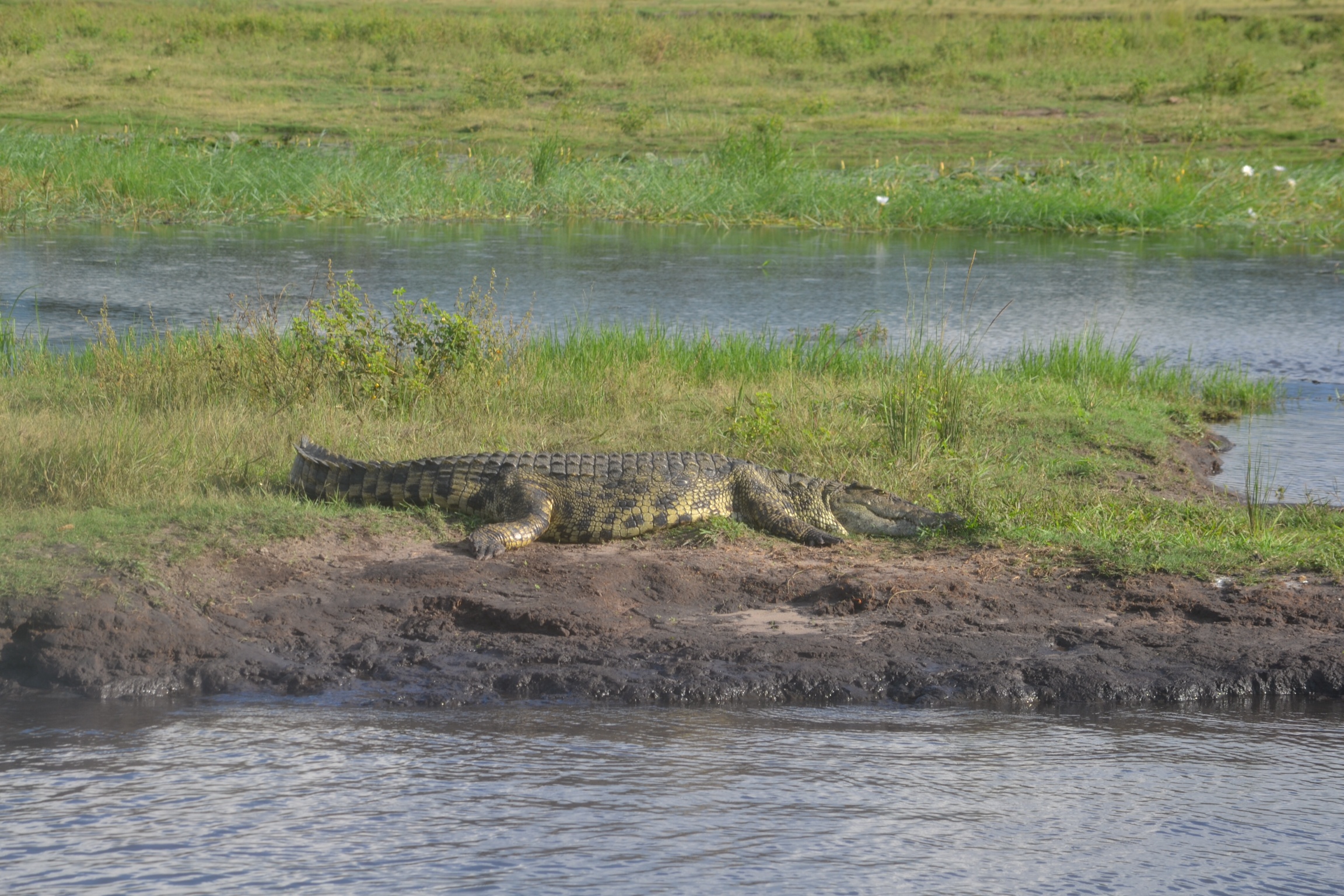
Croc

Croc

Three Slovenian doctors were also on our transport and I quickly befriended one of them, Mikha, once we’d settled into chairs on the roof of the boat. I listened with keen interest as he spoke to me of his recently ended three-month volunteer experience as a physician at a trauma hospital in Zambia. Working with limited supplies and with an predominantly HIV-Positive patient pool, he said it had been an incredibly intense learning experience that left him very much in awe of the African doctors and their coping skills, as well as a profound realization for how cushy he’ll have it in comparison as a General Practitioner back in Europe. He said he had also grown very fond of the relaxed method of time keeping Africans employ, namely if a meeting was called to start at 8am, it might not actually begin until 930 when everyone felt like showing up.

The time spent viewing game on the river was very pleasant indeed, if blisteringly hot. The upper deck was occupied mainly by an Australian group who’d taken it upon themselves to bring an entire cooler of cold beer along. It absolutely killed me not being able to have one myself – though I did offer payment for one and was unfortunately, turned down.

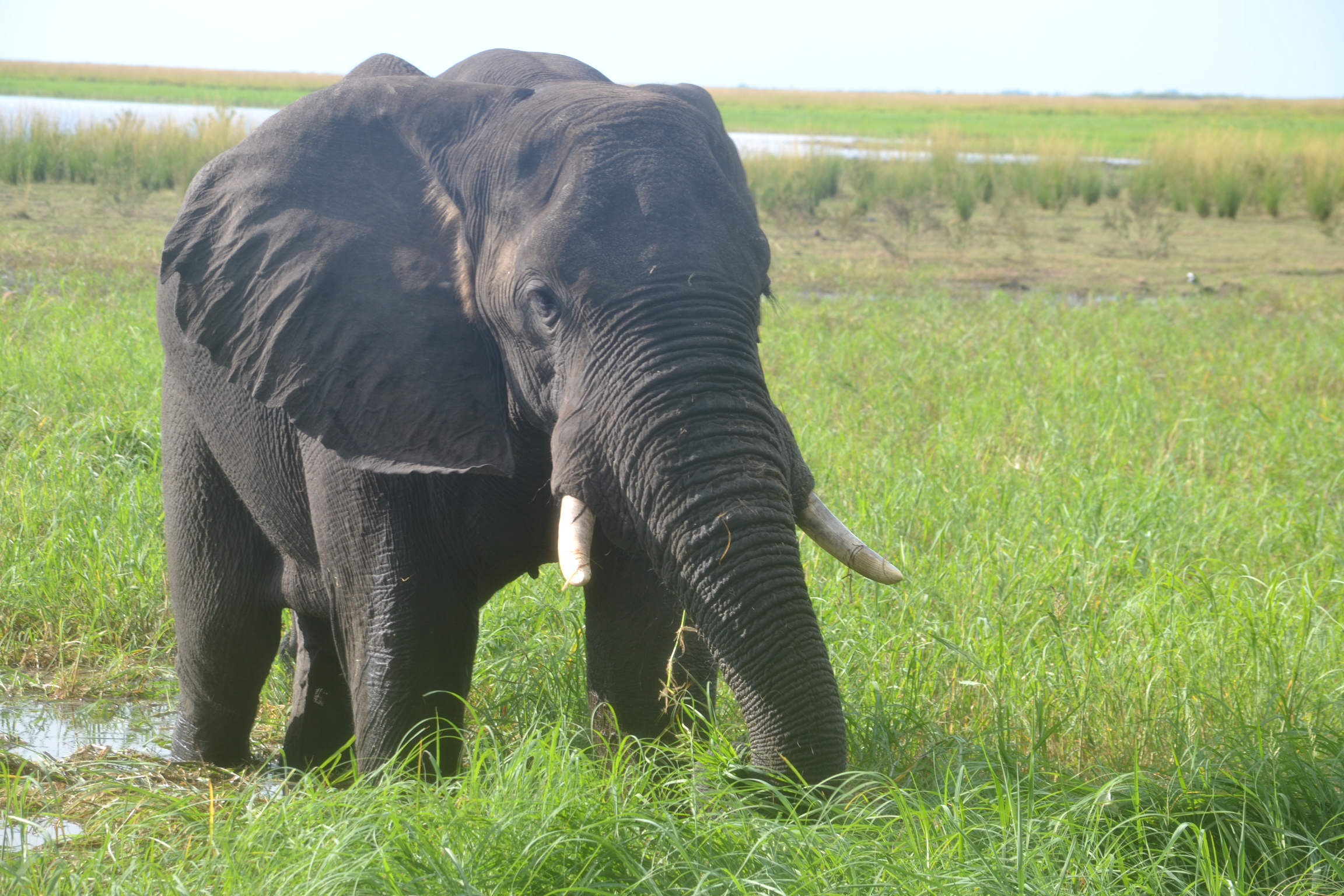
Elephant

Elephant

A safari by boat is a much more relaxing experience than in a vehicle. The elephants were happily cavorting in the water, the hippos waddled in the mud, and the crocs stayed cool by keeping their mouths gaping open. Chobe is quite green and was altogether a very pleasant place to call home, if you were an animal (in my opinion, vastly superior surroundings to the harsh arid Serengeti).

We were further rewarded with an incredible sunset as we turned the boat around at the half way point. And then the darkening skies were further enhanced by a rush of storm clouds that began to rumble with thunder. The clouds almost looked like a tornado funnel as the wind picked up and lightning flashed across the sky. It was quite ominous and the temperature plummeted making me super grateful for having brought my warmer layers.

And then the rain fell. And fell.

Hippo at Chobe

Hippo at Chobe

By the time we ran back to the tents on the return journey, the campsite had turned into a sandy swamp. Everyone was running around desperately saving gear from getting wet, and securing rain flies on their tents. Then we all headed to the bar as the only dry refuge in the camp, where we greeted by a rare treat – beer on tap!

The following day was a super early start and it was quite miserable rolling up the wet tents in the soggy ground and getting away by 6am. We had another long drive today, this time to the town of Maun which would be our setting off point for a 3 day/2night trip to the Okavango Delta.

Victoria Falls – Getting Up Close and Personal

Tags

,

Victoria Falls from the Zambian side

Victoria Falls from the Zambian side

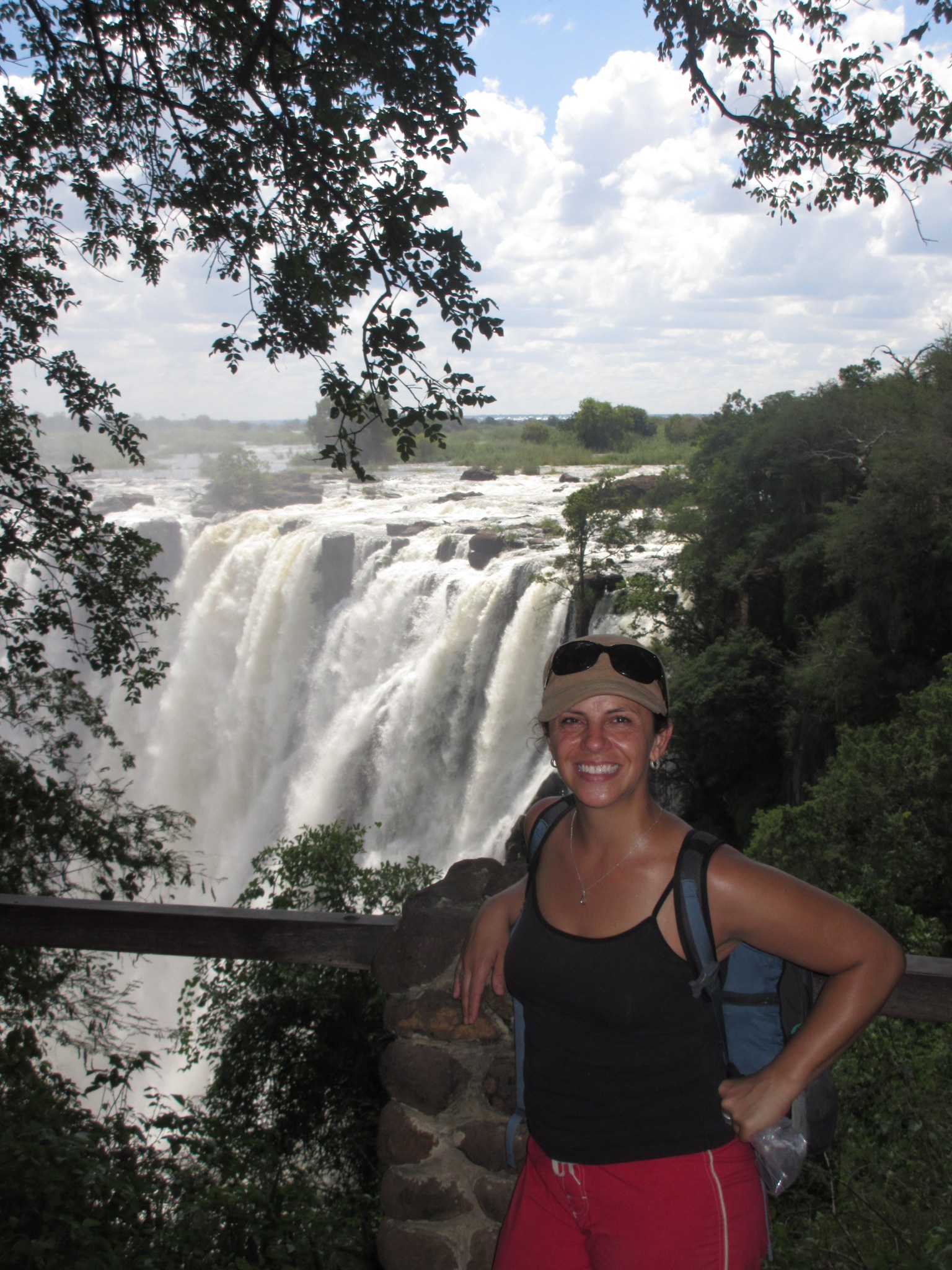
Standing right at the edge of the falls

Standing right at the edge of the falls

The town of Victoria Falls itself is quite small and as you’d expect, extremely touristy with prices to match. At $15 for a salad for lunch, it felt more like I was back in Bellevue than still in Zimbabwe. But this is home to one of the natural wonders of the world – Victoria Falls – and I was still looking forward to being able to witness and experience this natural phenomenon.

Lots of the group were busy arranging adrenaline activities such as gorge swings and bungee jumps, but I was content in planning my 3 days around the falls themselves, both on the Zimbabwe and Zambian side together with a single excursion to Livingstone Island and Angel’s Pool – which we knew frightfully little about since only Zambian tour agencies offered the activity and therefore the Zimbabwean companies didn’t stand to profit from selling the activity. Luckily, I’d opted to go and gotten the double entry visa, which would enable us to walk across the border and back to Zim on a day trip.

I arrived rather beleaguered and bedraggled after a long and largely sleepless night on the overnight train from Bulowayo. This was a locals’ train, full of Bulowayo workers who were returning to their families in the rural areas of the country for the weekend. It was slow and stopped a lot. Plus, the inside of the train actually made the Indian sleeper trains I’ve journeyed on seem clean and comfortable – the interior was rather smelly, dirty and dysfunctional….but I absolutely loved it. It felt like we had stepped back in time and were experiencing something from a bygone era – and it seemed romantic and ideational to me.

Afternoon Tea at Victoria Falls Hotel

Afternoon Tea at Victoria Falls Hotel

However, after settling into our two carriages, one for the party-going crowd, and one for those who actually wanted to sleep – it became very obvious early on that the wishes of the former were going to supersede the latter. Walls were paper thin, and despite the fact that our carriage had maybe 5 or 6 cabins, some containing families with small children, the Oasis revelers decided to blare music, dance and sing till 3am…forcing the rest of us to succumb to a sleepless and frustrating experience. My personal request for them to turn down the music around midnight was ignored and laughed at, which resulted in the state I aforementioned upon arrival.

Compounding my bad mood, the truck had not yet arrived to the campsite when we got there, and there wasn’t anywhere to even sit while we waited for our things so we could shower or change clothes. Eventually the truck arrived, and I managed to re-humanize myself to the point where I felt I could go and enjoy a lavish afternoon tea at the Victoria Falls Hotel.

We were joined by 3 additional group members in Victoria Falls, so our truck experience was gonna get more crowded but I was also looking forward to getting to know the new travelers. One of them was Australian, and I enjoyed chatting to him over our clotted creamed scones, finger sandwiches and cakes in the impressive garden setting of the high tea. It was also fun sharing the English tradition with the Frenchies – Sandrine and Benoit had not had high tea before and seemed to really enjoy it.

Photo Bombed at Zambezi Gorge

Photo Bombed at Zambezi Gorge

Other than the high prices, the other surprising fact about Vic Falls was the abundance of wild animals that just freely wandered around the town, especially after dark, making it slightly hazardous to do so. Warthogs were in abundance, and two members of our group were also false charged by elephants early in the morning.

By far, the highlight of my stay was the Zambian excursion to Livingstone Island – a land mass that stands directly at the top of the falls, lending itself to access to water that is literally on the precipitous and highly dangerous (especially in the wet season) edge of the 108 meter water fall.

We loaded onto a speed boat for the ten minute boat ride out to the island where we were met by a guide who talked to us about David Livingstone’s first trip to the island and how it got it’s name. Devil’s Pool – the more famous of the two pools that one can sit/swim in at the top of the falls, was closed for the season due to the high volume of water. However, the guide assured us that the only real difference between the two pools was that one could walk to Angel’s pool and swim in Devil’s. In his opinion, the view from Angel’s pool was superior.

At first, we were directed to don our swim suits and shoes and make our way across the muddy marshes to a viewpoint that was very close to the edge of the thunderous cascading water. This, in and of itself was extremely thrilling, and I managed to get some great photographs (though my camera has ultimately paid the high price of being water-damaged – the screen has short circuited, making each photo a completely random guessing activity -adding yet another technology failure to my trip thus far.)

Then, words fail to describe what it felt like when the guides lead the way to the Angel’s Pool itself. Holding our hands one by one, we were lead to a mound of grass where the view was completely unobscured all the way down to the very bottom of the canyon and river below the falls. I couldn’t believe my eyes and heartily agreed when my guide assured me “You will never be able to do or see this anywhere else in the world.”

For the fourth time in my travels, a place possessed such beauty that I found my eyes welling up with tears all on their own (for those interested, the other three are Ayers Rock, Mt McKinley, and Machu Picchu.)

Inadequately comforted by the two ropes outstretched at the falls’ end of the pool, supposedly a last ditch grab hold should one of us lose our footing in the rushing forceful water, I followed the guide into Angel’s. All holding hands together, we ventured and sat in the pool of water literally watching as the water left our bodies and cascaded 108 meters only a handful of feet away from us. I let out an automatic shriek as one of our group did momentarily stumble and floated into one of the guides’ bodies who fortunately grabbed him and set him back upright. This was a location that was altogether wondrous/exciting while simultaneously terrifying. Left to imagine the worst, I found myself quite eager to get my feet back on dry land after the first few minutes.

But what a rush.

Afterwards, we were literally spoilt rotten by an incredible breakfast of Eggs Benedict, bacon, sweet breads, jam and coffee before being jetted back to the luxurious boat launch of the Royal Livingstone Hotel.

Baboon at the falls

Baboon at the falls

As for the visitor areas of the falls themselves, we spent that afternoon exploring the Zambian side, and I had enjoyed the Zim side the day prior.   Based upon the numerous and conflicting opinions as to which side offered better views, I have concluded that it depended more upon the weather and prevailing wind on the day you chose to make your visit, than any objective aesthetic quality. Personally, I found the Zambian side to be far more impressive in scope, and the additional walking paths lent themselves to making the excursion more interesting. We spent a good few hours’ taking in the various viewpoints on both sides of this natural wonder, and I had the additional fun experience of being slapped on the hand by a baboon who was reaching for my water bottle. Additionally, on the Zambian side, one is able to walk down to the river level, adding an additional perspective on this immense landmark.

A final memorable encounter occurred on the Zim side, when Nessa and I met with a man by the name of David who was born and raised in Zim – I believe I mentioned him in a previous post. He was back in Zim visiting sites that he remembered from the war of 75-81. He hadn’t been back in the country since and had re-made his home in South Africa. He told us, emotionally, what it had felt like to come across a tree at one remote location south of the falls along the Zambezi, where he and three of his cherished and since long passed away friends had engraved their name and the date.

Malingering on the current state of affairs in South Africa, David spoke about his plans to move to Australia. However, he also spoke with sadness about leaving his beloved Africa. He assured us that no matter what, this land would forever be in his blood and heart and nowhere else would ever feel like home.

I for one believed him.

Matopo National Park – Rhinos, Bushmen, and Cave Art

Tags

, , ,

Checking out Dung Beetles on our Rhino Safari

Checking out Dung Beetles on our Rhino Safari

Matopo National Park is home to 56 black and 43 white rhino, both species highly endangered due to the value of their horns reaching a value of $100,000 per kilo.  The difference in the species is primarily that the black rhino has a double horn, making it even more vulnerable to ugly poaching.  We spent an entire day in the Matopo bush with our Zimbabwe tour guide, Norman, who himself had a very interesting story to share with us of his life as a white Zimbabwean who had elected to stay in the country despite the civil war and subsequent land grab that made life here so dangerous and difficult these past thirty years.

Taking in the view in Matopo National Park

Taking in the view in Matopo National Park

We set off from our hostel in the early morning hours, the many layers that I had put on still not offering much in the way of warmth in the freezing open safari vehicle we were in that blew the wind and rain on us on and off all day.   It was not a warm day, and I was beginning to miss the unbearable heat…if that was possible!

Norman gave us some history of the English explorer, entrepreneur, diamond miner, and politician Cecil Rhodes who first came to Zim and found his home and a wealth of natural resources that he could exploit and profit from.  Of course, the land was eventually named after him – Rhodesia – before the Mugabe government changed the name after the medieval ruins we’d visited several days prior.  We saw his first homestead and ended the day visiting his grave.  His story is rather impressive, and he accomplished much for someone who died right before achieving his 50th birthday.

Matopo National Park

Matopo National Park

The park itself has really cool rock formations that are basically layers of sedimentary deposits that have been weathered and subsequently formed really unique shapes, caverns and round, ball-like structures that were inhabited by the original indigenous of Africa – the San Bush men…who sadly, have dwindled in numbers as has their traditional way of life and culture subsequent to the migration of the Bantu and the white people into their homeland.

Norman was quite the expert, and knew a lot about rhino, the Matopos, and the anthropology and ways of the bushmen, making for a very entertaining and educational day.

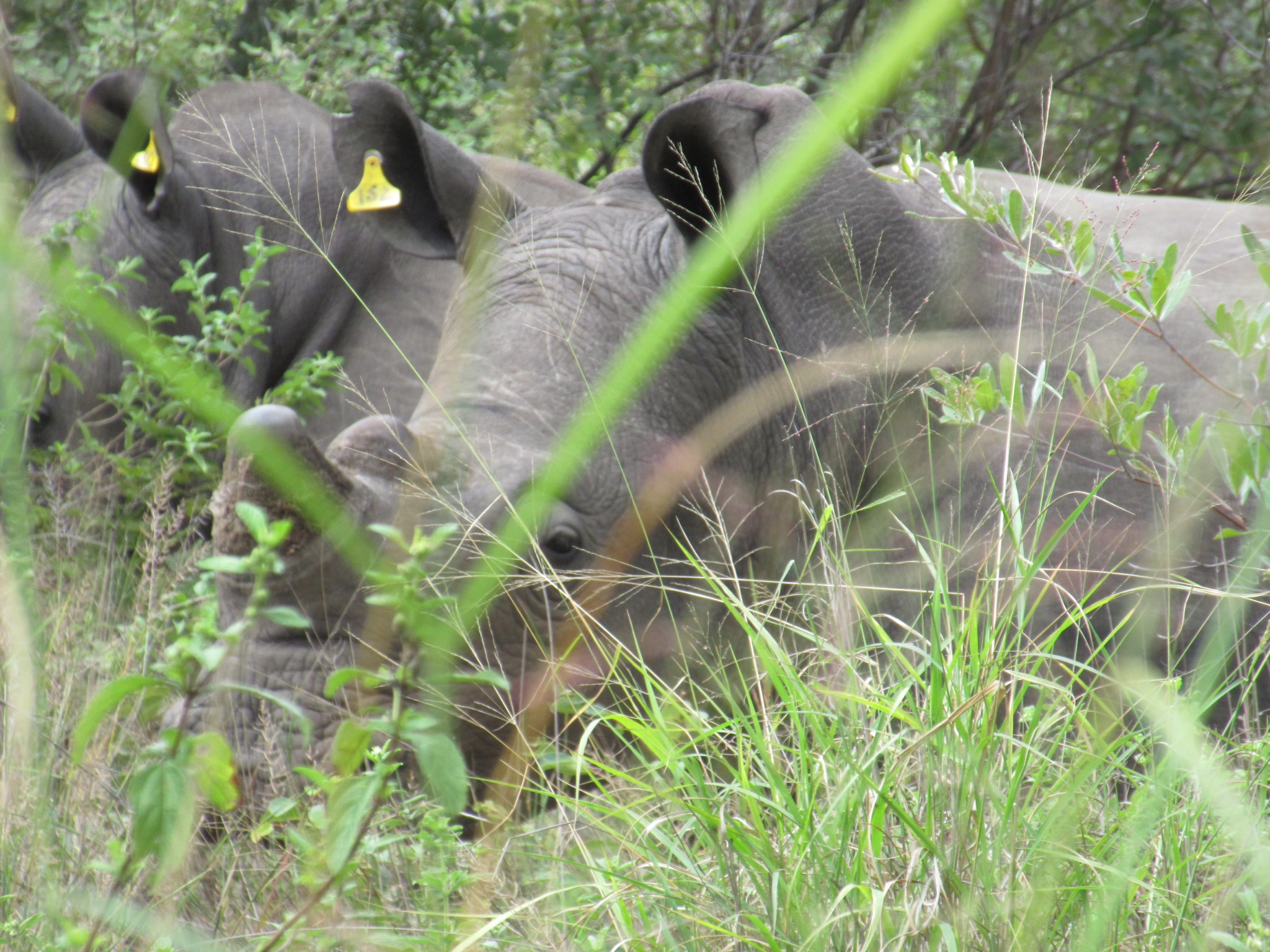
One of the White Rhino we observed at very close range

One of the White Rhino we observed at very close range

Of course, the highlight was trekking into the sparse trees and bushes and discovering a family of about 7 white rhino and getting to observe them from a very close distance.  Norman informed us of how to behave to avoid any provocation of these sensitive massive animals.  We gave them our scent by approaching with the wind, and then stood quietly at a distance while they checked us out and indicated their comfort with having humans so close by deciding to lay back down in the undergrowth and mud.

What was most surprising and humbling about getting so close to the rhinos, was the sounds that they made!  Especially the little one that was very vocal in communicating with its mother.  The only way I can describe the noise they make is that it sounds rather like recordings I’ve heard of whales in the ocean.  A rather sweet, high pitched little squeal.

The rest of the day Norman took us on bush walks and taught us how we could survive out here with no water, food, or shelter – something of a specialty knowledge he possessed .  He also took us to some cave paintings that are estimated as being over 20,000 years old, but not containing any trace of carbon (the San people used bile from an animal’s gall bladder, mixed with it’s uric acid to create the paint they used) it is impossible to accurately estimate the age of the artwork.

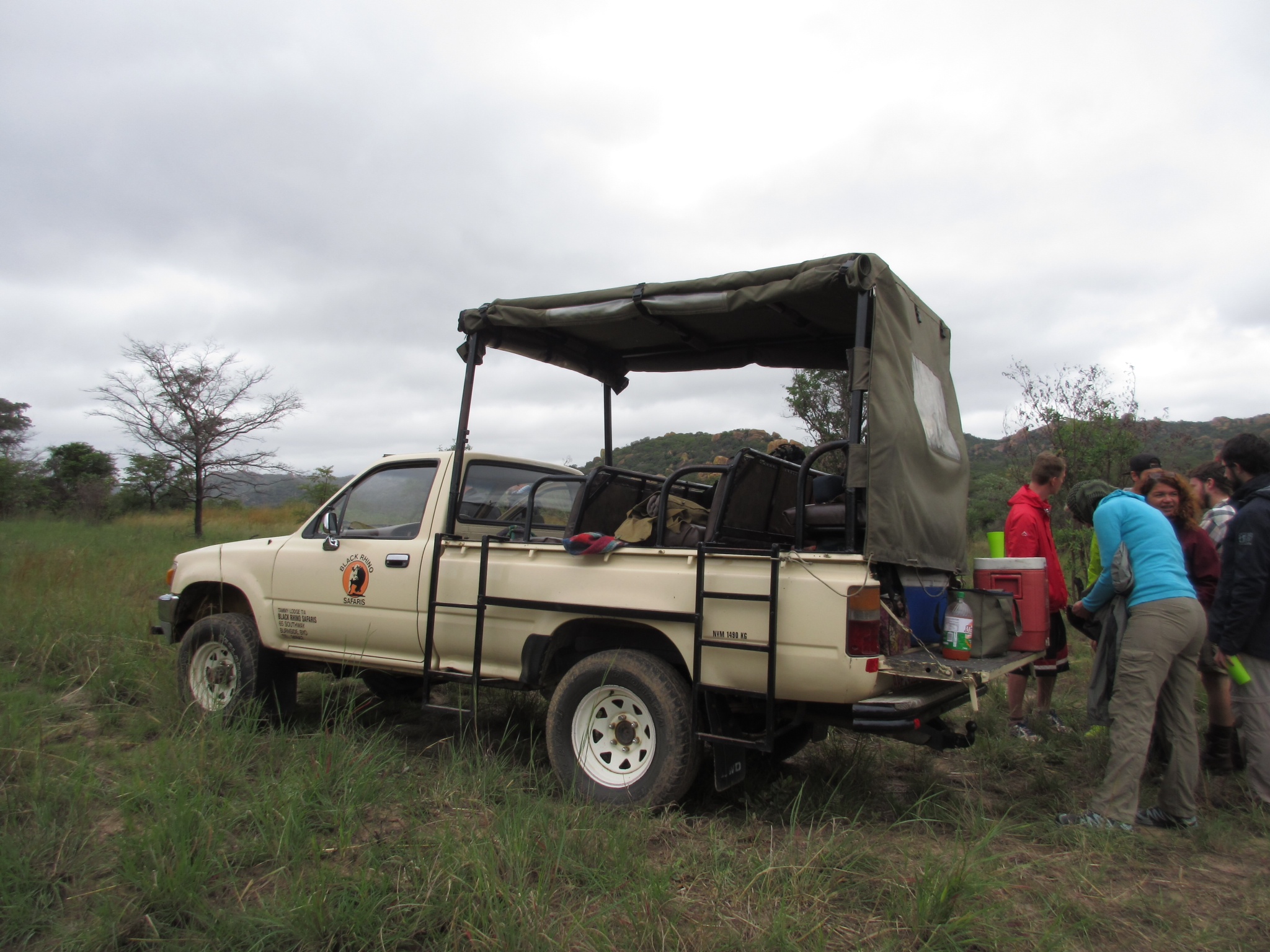
Our Safari Vehicle

Our Safari Vehicle

Norman also gave us a fascinating history of the San people’s way of life, together with a demonstration of their remarkable language which is basically a series of clicks.  Less than five feet in height, with a light brown skin,  and slightly angled eyes…they do not resemble any other people in this part of the world, which I found very interesting indeed.  Anthropologically, Norman said that they could easily have co-existed with today’s Australian Aborignies when the two continents were connected.  There are certainly lots of elements of both people’s culture that is similar – the concept of ownership of things is very foreign to the San, only take from the earth what is needed at this very moment, live in harmony with nature, live in large family-based groups that share all resources…to name but a few.

I managed to capture on video Norman giving his best impression of their incredible language and I will, hopefully, be able to share it with you on YouTube once I’m back in the land of functioning wifi.

Ancient San Art

Ancient San Art

Norman himself also gave us an account of life during the war of 1975-81 which we asked about with trepidation, after having been giving some very severe warnings about refraining from any political conversations while in Zim.  Together with an account given to us by another white national whom we met in Victoria Falls, I have now formed at least a semblance of an idea of what happened during this period in history, and more importantly, what it was like to live through it for someone who elected to stay in the country (Norman) vs. flee to South Africa as David had.

Roughly half of the 30,000 white army that formed to fight for land rights and for homes during the war perished.  Both men recounted the names of friends and family members that they had lost.  They talked about how their country used to be an economic stronghold, and major exporter of foodstuffs such as maize and beef, feeding much of Southern Africa, only to now be reliant on incoming aid and import to feed their citizens.  They talked about the land grab of 1998, where thousands of white farmers had their land and homes taken from them by force, many of them losing their lives in the process.  David, whom we’d met in Vic Falls, talked about how a friend of his watched in horror as her husband was beaten to death, only to escape into the rocky hills behind her farm and walk 40 miles through the night to the Mozambique border, and then re-settling into South Africa with nothing but the clothes on her back.  The situation is far from simple, and there are improvements being made…but hearing their firsthand accounts was very compelling and makes me want to do more of my own research and reading on the subject.

The one thread or element in both men’s stories that united them was this – a palpable love for their home country.  Nowhere else on earth would ever enter their hearts the way Rhodesia, and now Zimbabwe has.  

Medieval Ruins and Big Cats – On the road in Zimbabwe

Tags

,

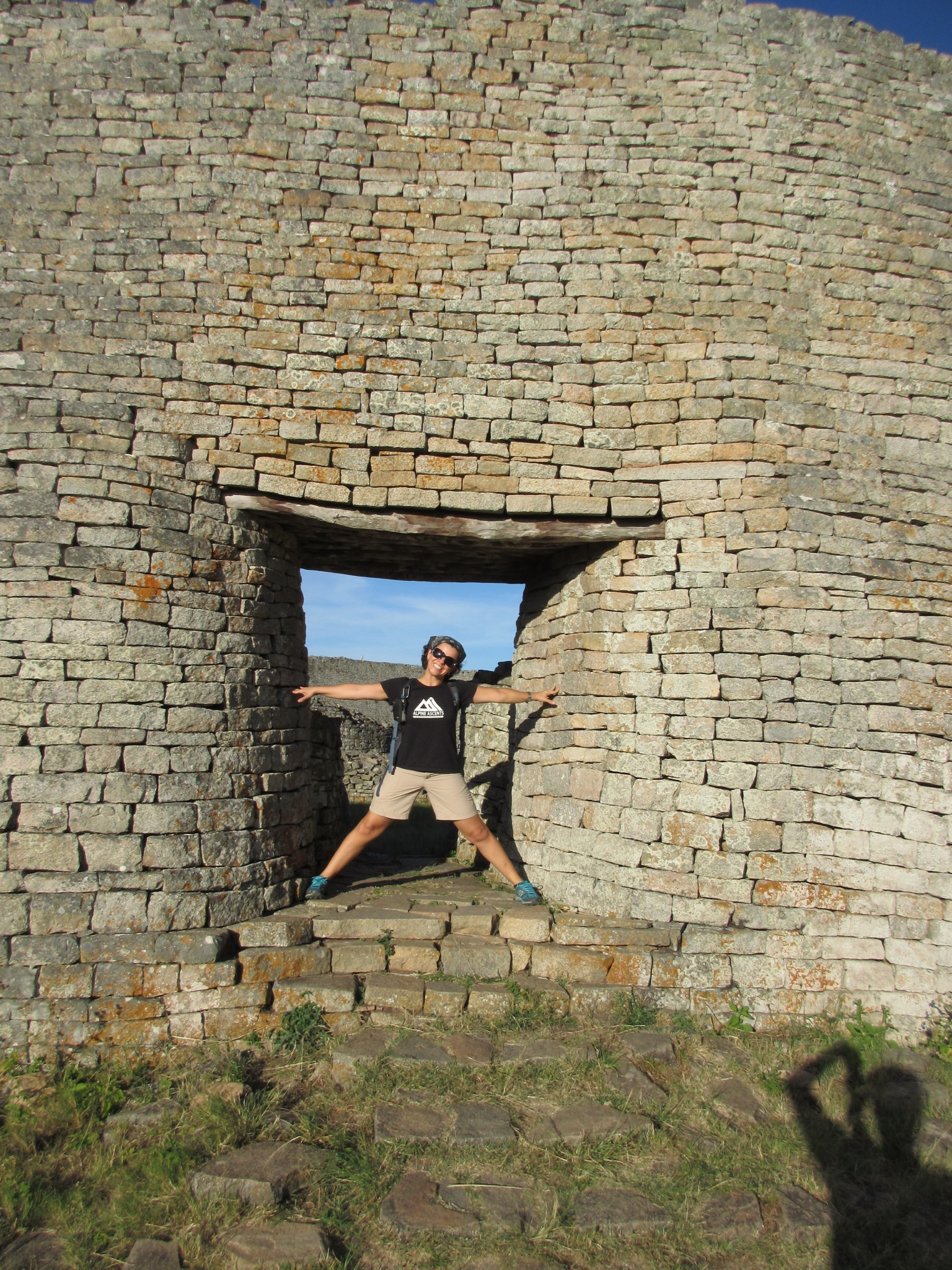
Me at the Great Zimbabwe Ruins

Me at the Great Zimbabwe Ruins

This post is from events that occurred on 4-7 April, 2015.

We had another long day in the truck driving today towards the namesake for this country – The Great Zimbabwe Ruins, a UNESCO World Heritage site – one of the four stone monuments in the world with Machu Picchu, The Great Pyramids of Egypt, and The Great Wall of China.  This represents the only medieval ruins in sub Saharan Africa and the ruins themselves combine with the rocky natural landscape in a way that is very similar to Angkor Wat – a place that has grown symbiotically with trees.

Unfortunately, I will need to do more independent research on the story and history of this place since our tour guide had such an incredibly strong and difficult to understand Zim accent – I barely grasped a quarter of what he said.  The parts that I did understand included learning about the structure of society for the 12,000 or so inhabitants of the city in the 15th century, that the boys entered long initiation classes to teach them how to be warriors and hunters, where the young women received classes on how to be good wives (I know, shocking, right?)  The stones themselves that were used in the construction of the city were granite and forged with fire that when cracked, formed straight cuts that allowed for the bricks to be layed one on top of the other without cement – though far less accurately or aethestically pleasing as the stones used by the Incas in Peru, in my opinion.

Climbing to the summit of the city – we learned how the king in those days would have to show his uncommon and worthy strength by wrestling a crocodile, bring the crocodile to the ceremonial plaza at the summit, and proceed to have royal incest with his sister on top of that crocodile – all in an effort to prove that he was worthy of ruling over his kingdom.

Damn.

Walking with Lions at Antelope Park

Walking with Lions at Antelope Park

Archaeologists are still struggling to excavate and uncover more artefacts at this site, but our guide told us that the last attempt to work on the ruins resulted in the scientists abandoning equipment in the depths of the buildings due to being terrified by the spirits that haunted ancient caves and cellars.

It was an enjoyable evening and we even had the opportunity to observe families of baboons, blue balled monkeys (yes, you read that right) and rock rabbits.  Plus, we camped only a few minutes’ walk from the grounds, so after preparing dinner for the group, it was a simple process to roll into my tent and collapse asleep.

From there, we were heading to Gweru, the home of Antelope Park – a private Game Reserve where they are attempting to breed lions and then raise the captive lions, teach them how to hunt, allow them to reproduce, and then take their descendants to release back into the wild, in an attempt to increase the numbers of lion populations that are rapidly dwindling.

Based on initial impressions, Antelope Park looked like it was going to be a very expensive zoo experience.  However, after initially listening to the sales pitch with extreme skepticism, we were impressed by the passion that the research scientists showed for the conservation of the lion, and their attempts to also involve the local community in their efforts to save the lions by providing jobs, community investment into schools and orphanages, and also charging for some pretty unique animal experiences that are not available anywhere else on the planet.

I decided to sign up for the lion walk, a horse riding safari, a night encounter experience, and the lion feed.

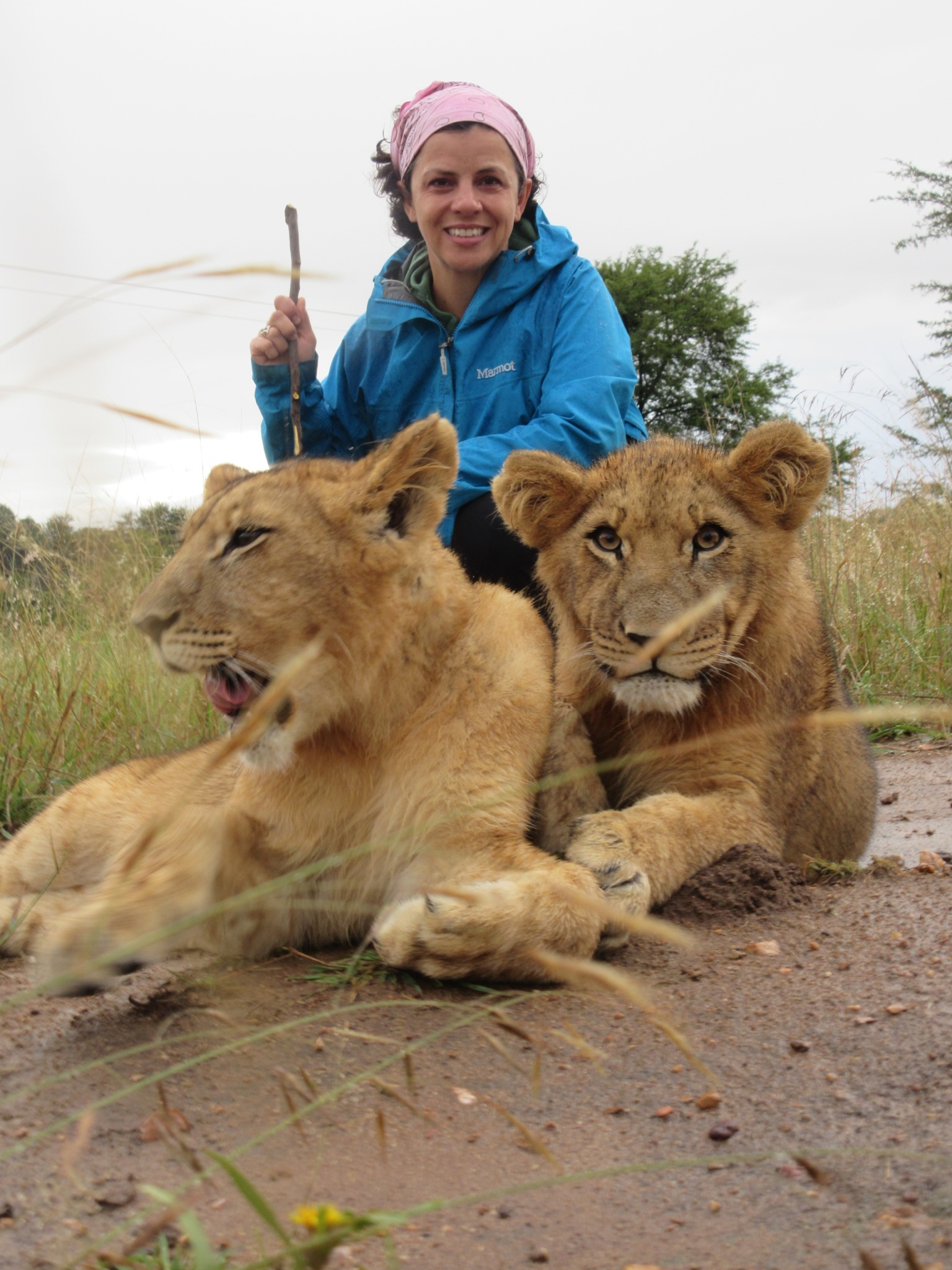
Me and the Lion Cubs

Me and the Lion Cubs

Our first day at the park was marred with a tragic episode.  It was Easter weekend, and a huge Christian delegation had descended upon the park and were busy in their festivities – we were in for a lot of prayer, singing and families picnicking in large throngs.  We were being given a tour of the facilities and grounds when the air was pierced with a scream that could only signify something very bad had happened.  Hundreds of people began gathering around the pool, and we looked on, horrified to see that a little girl had just been pulled out of the pool, lifeless and not breathing.

Luckily, several of the guests were doctors and performed CPR on the girl for the next half and hour while everyone waited for an ambulance to turn up.  People prayed, held hands, and looked on, unable to tear their eyes away.

Our orientation canceled, we spent the next few hours hearing the crowds of worshippers praying, and singing for the recovery of the little girl.  We later learned that she did die – and it certinaly cast quite the shadow over our arrival.  I was reminded of Jennifer – the girl who drowned on my diving trip to the San Juan Islands 5 years ago. It was horribly sad – especially when we considered that the girl’s mother failed to watch her kids in the pool, despite knowing that there were no lifeguards on duty and that the girl was not a strong swimmer.

The sadness from the day before was magnified by a very distinct change in weather on the next.  The rainy season was now in full force and we had a night of very heavy rain and even a thunderstorm.  The rain, however, didn’t dampen our spirits as we went out to watch a Lion Feeding.

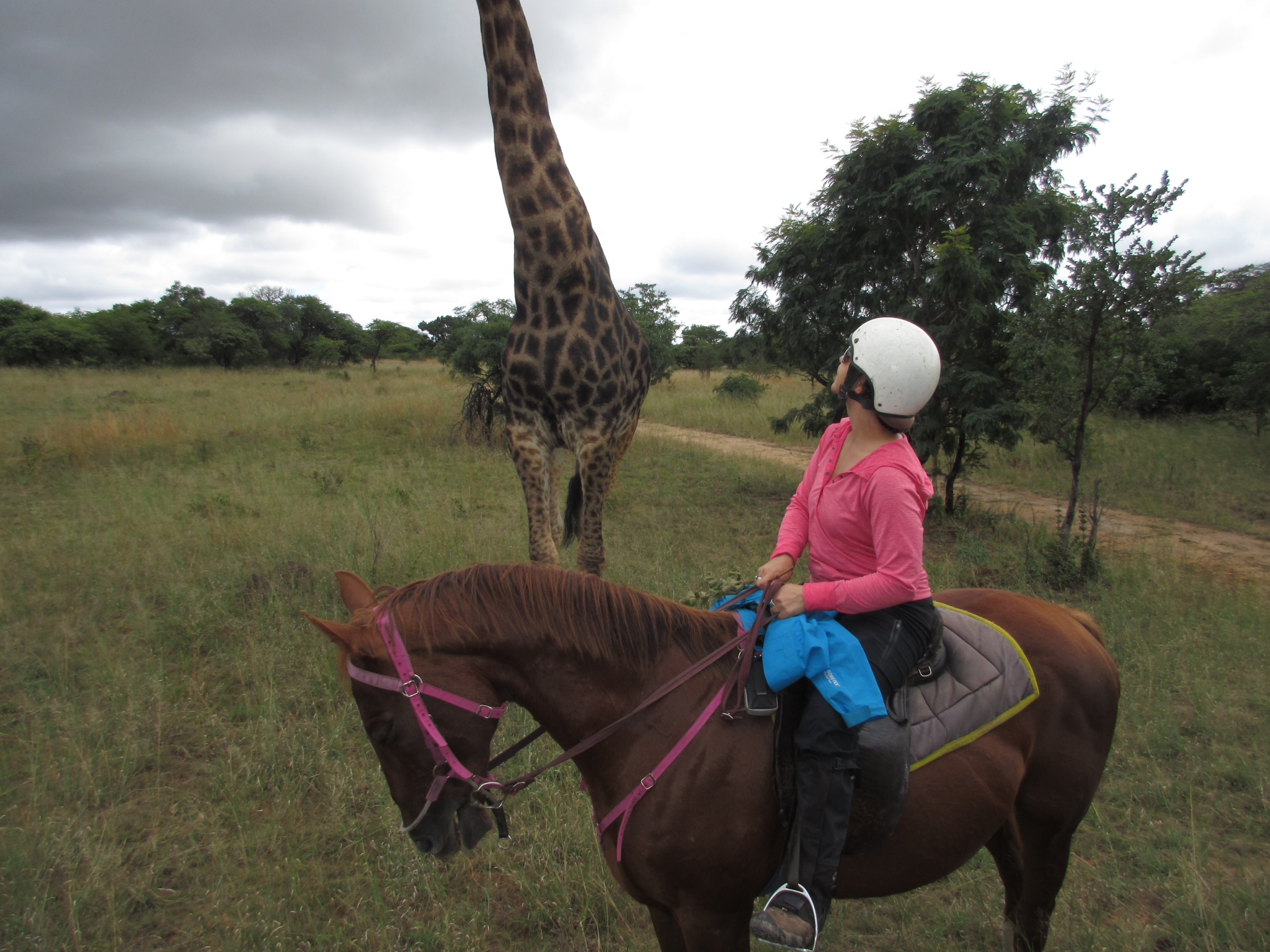
checking out a giraffe on my horseback safari

checking out a giraffe on my horseback safari

The activities were well worth the money that was charged.  We got to watch Lions being fed an entire cow carcass, being released from their enclosures in a large group that then literally charged towards us and the meat, the only separation between us being a thin chicken wire fence.  I can’t tell you how it felt to see these king of beasts charging seemingly right at you as if intent on taking your head off.  I managed to get really great video footage by poking my camera through the fence, dropping it however, a few moments later when one of the Lions literally jumped right at us onto the fence and I shrieked in an autonomic response of adrenaline fuelled fear.

Wow.

The weather was unabating and we enjoyed a game of South African Trivial Pursuit in the bar that afternoon while the heavens unleashed a deluge on our already water logged tents.  We did manage to catch a peak of the “resident” elephants swimming across the river, and emerge literally right in front of the lodge bar where we were playing.  It was amazing to be this close to these magnificent creatures.

The cubs that are raised from the breeding efforts are taken from their mothers when they are very young so that they “bond” with the trainers as if they are the lions’ parents.  The cubs are then walked each day at least twice, as a way of the beginning process for teaching them how to hunt.  We were invited to walk with a couple cubs who were about 10 months old at dawn.  The cubs were adorable, playing with one another as brother and sister, chasing each other, rubbing against our legs and generally behaving like cuddly kittens instead of the wild powerful animals that they are.  I got the chance to walk alongside the lions, pet them and be photographed with them, and it was wonderful.  Something I will not soon forget.

Great Zim Ruins

Great Zim Ruins

Since the game reserve was also well stocked with other game – giraffe, springbok, antelope, impala, waterbuck, zebra, wilderbeest and other deer – I opted to go on a horseback safari since I’d yet to go on a horse ride, and this opportunity also afforded me the chance to get super close to the animals as well as enjoy being on horseback.

What I didn’t realize, until we were already well into the bush, is that the horses we were riding were trained thoroughbreds, and mine had also competed for years as a professional polo horse.  This horse, named Waverunner, had an interesting personality.  He only liked to amble slowly, and then would trot to catch up to the other horses.  However, if the other horses decided to go fast – he was intent on outpacing them almost immediately.

We cantered several times and Waverunner almost broke into a gallop on several occasions, manoeuvring around bushes and trees with the dexterity of a polo horse.  It was quite a challenge just staying in the saddle.

It was also unique being able to get so close to the wildlife.  At one point, we came across a small herd of giraffe, and my horse was comfortable approaching one of the older males to within a few feet of him.  Craning my neck upward to see his face, so close to my own, was very special.

Lion with his carcass at the Lion Feed

Lion with his carcass at the Lion Feed

The highlight of our three day stay, however, was the Night Encounter.  Basically, the slightly older cubs (in our case they were 24 months old) are released from their enclosures once a week or so (that’s how often Lions’ typically  feed) and will follow their “parents” in the safari vehicle as they are led out at sunset to view the game, and hopefully make a kill and get their supper served extra fresh.

I had low expectations despite the trainers telling us that we had a 50/50 chance of seeing the lions’ efforts meet with success.  Just seeing the lions following us in the truck was a thrill in and of itself.  I will never forget the trainers ‘ thick Zim accents cajoling the felines with “Come, come , come, come come!  Come, Lions!  Good, Lions! This way, Lions!”  It was hilarious..

The three lions also played with each other and at one point had a little tussle that resulted in a catapult-like jump mid-air right in front of our open air vehicle.  It was a scene directly out of The Matrix, and we all held our breaths when we saw it – feeling that we had already got our $95 worth.

We were in for a real treat.  As the sun was setting, our truck came across a herd of wildebeest and zebra and we watched the lions create their hunting formation, splitting into 3 separate tracks as they began a super exciting chase that we got to watch as the sun was setting.  It was incredible, and I really got the feeling that we were also on the hunt…side by side with the lions.

Unsuccessful, the lions looked tired and a little discouraged.  Driving on, it got really dark, and the trainers “helped” the lions by using a red beam light that when scanning the horizon, immediately picked up any sign of life by illuminating the glowing eyes of any unfortunate prey that was around.

Soon enough, our truck crew spotted a single creature – an impala, who was by himself – indicating that he was probably one of the weaker members of his group, since he’d been left alone by his herd.  We circled around the creature until a clear path was established that the lions could take to make their approach to the lone animal.

We watched, our breaths held, as the lions disappeared into the tall grass.  What seemed like only a few seconds later, we saw the impala take a giant leap into mid air, only to then disappear into the brush with a lion attached to its neck.

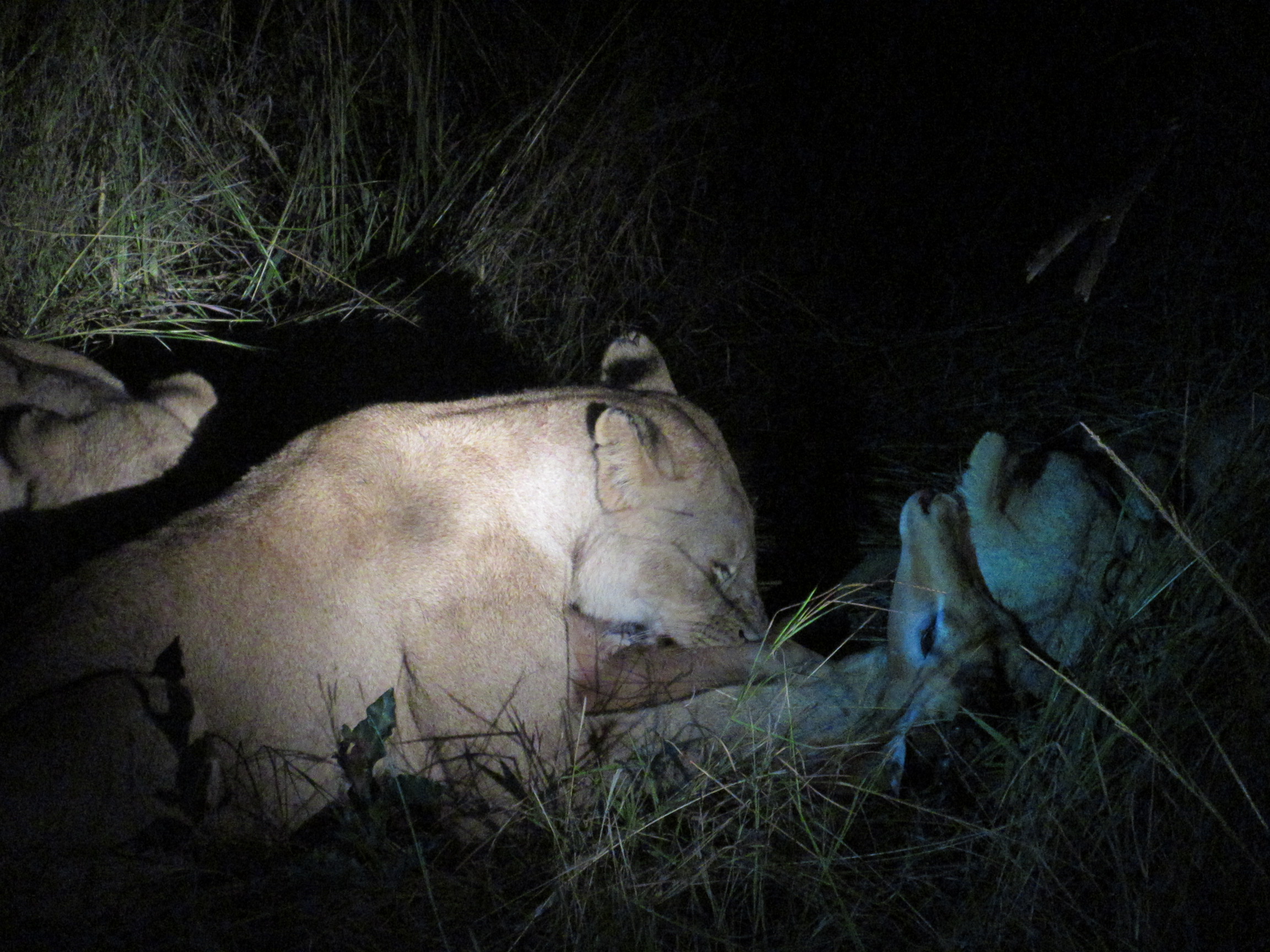
“We have a kill! We have a kill!” our driver yelled out, and we revved into high gear as the land rover drove within a few feet of where the lions were in the process of the rather gruesome task of killing and eating their dinner.

One of the lions had it’s teeth in the poor impala’s neck , while, rather surprisingly, the two other lions proceeded to lick the impala’s body.  Asking what this meant, we were told that the lion was just figuring out the softest spot for its first mouthful.

The Lions with their "kill" - the impala

The Lions with their “kill” – the impala

After what seemed like a very long time indeed, and unfortunately, a long while after the lions had begun their chewing, the impala died and we watched in awe while they feasted.  It was disturbing, but at the same time, completely mesmerizing.

Even more surprising, the trainers leapt from the truck once the majority of the kill had been consumed, and dared provoking the hungry lions by pulling the carcass away from them, shooing them away, and putting what was left of the kill in the back seat of the truck!  We were told that it was important for the lions not to finish completely, as the carcass would split into 3 and the lions might be “lost” in the reserve to the dark night.  Instead, they would obediently follow the truck back to their enclosure where the remaining carcass was thrown for them to finish off.

And they did.  Which was quite remarkable.

Take Me to Church – Chimanimani National Park

Tags

,

Take Me to Church – Chimanimani National Park

Chimanimani Park

Chimanimani Park

Our overland journey next took us to the easternmost part of Zimbabwe, in the mountainous region of Chimanimani National Park, bordering Mozambique. I was looking forward to the cooler climate and to being able to get in some exercise and time in my personal church – the mountains.

We stayed in a lovely guest house called Heavenly Lodge, though it didn’t appear that it got many more guests than our overland truck every few months. Most overland trucks don’t make a stop here in this less visited corner of the country. The lodge itself was very cozy, and it really was cold that first evening, to the extent that we were very glad for the open fireplace and logs that our hosts kept stoking it with.   I decided to upgrade, and for an extra 5 dollars per night, I got a dorm bed – but it was in a dorm that no one else was staying in, so I essentially had my own room.

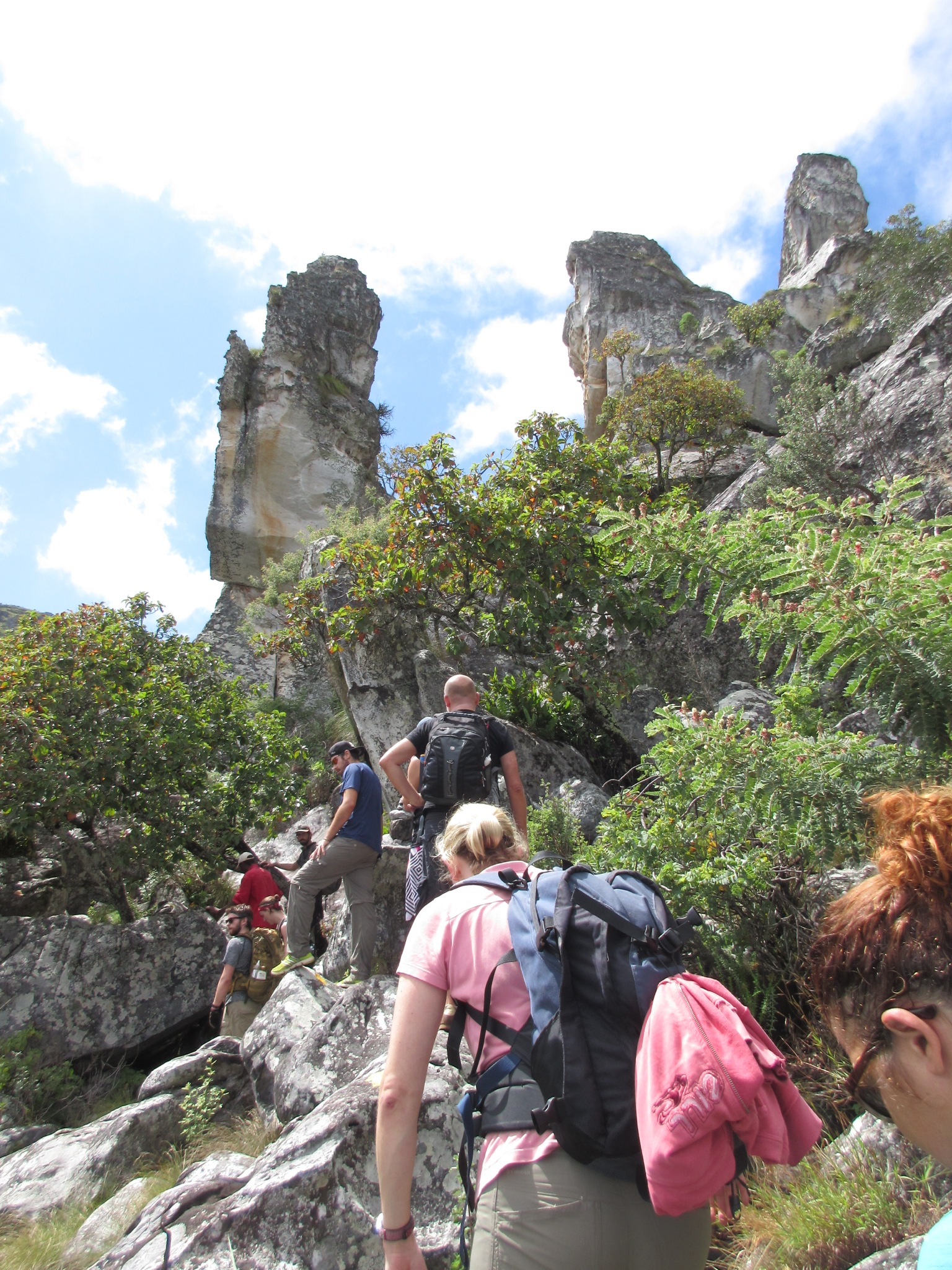
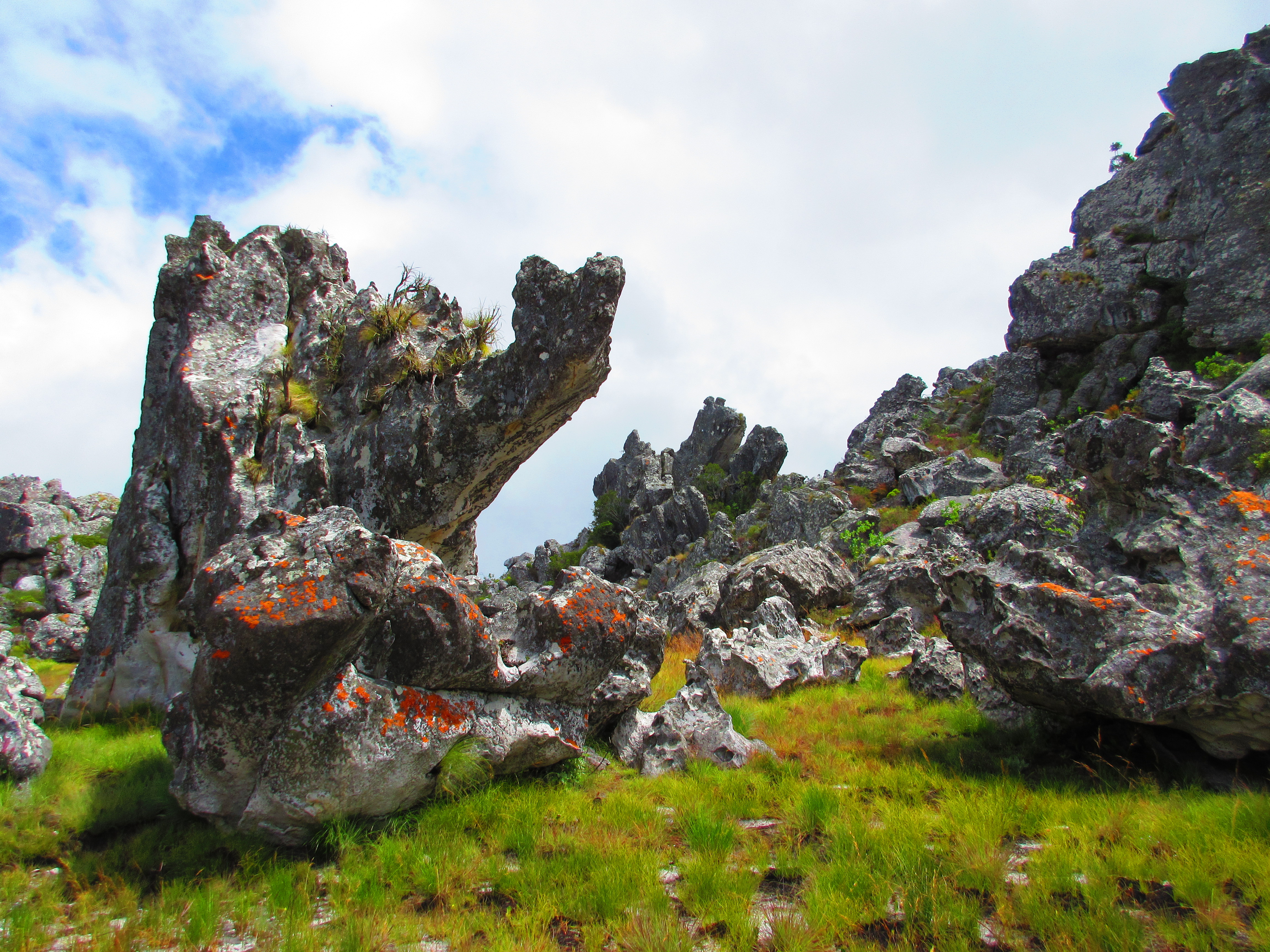
The following day the majority of the group crammed into a single Land Rover to drive out to the trailhead to hike to Skeleton Pass. This area reminded me very much of the Scottish Highlands, or even Snowdonia in Wales. Lots of lush green trees and tall granite peaks, with some very strange rock formations. Once we had climbed a good two thousand feet or so, the walking flattened out and we came into a vast expanse that was covered with really unusual grey rocks that did, in fact, look skeletal in appearance. It very much reminded me of scenes from Mordor in Lord of the Rings.

Skeleton Pass

Skeleton Pass

After a packed lunch enjoyed at the midway point, we made our way to the first waterfall of the day. Unfortunately, one of our group managed to cut away a large chunk of his knee leaping from rock to rock, and for the first time since my recent Wilderness First Aid course, I was able to apply some of what I’d learned by bandaging up his gaping wound. He made it back to the lodge just fine.

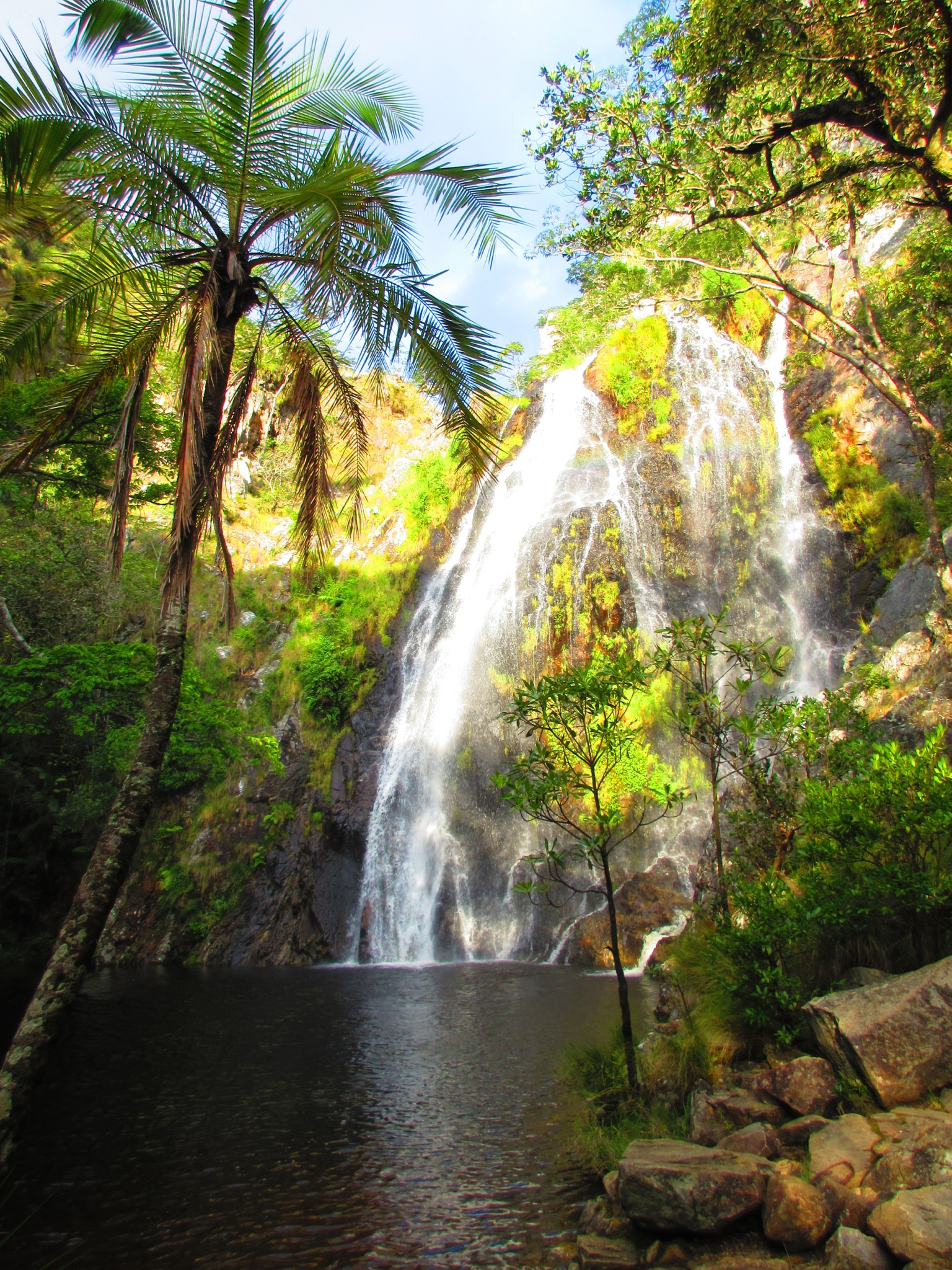
We ended our hike at Tessa’s Pool – a beautiful swimming hole with a gorgeous cascading waterfall. It was the perfect end to a strenuous day, though the water was extremely cold. We took it in turns to make big jumps into the water from rocks above the pool, and then swim over and sit directly underneath the falls.

I was in heaven. This is my church.


Tessa's Pool

Tessa’s Pool

That evening we enjoyed delicious local food which consisted of mutton (from sheep reared at the farm itself), the local maize based starch, and kale. It was delicious, and we were gleeful when our Zim host announced that she’d baked chocolate chip brownies for our dessert which we munched in front of the log fire, while it decided to pour rain down outside.

The following day, most everyone was already hiked out – but I decided to hike out to Bridal Veil Falls by myself as I welcomed two days in a row of strenuous activity.

I had such an amazing day, and actually really enjoyed having some solitude. The sun was shining, the scenery was stunning – rolling green hills busting with glistening foliage – and then after about a five mile hike – I found myself staring up at a stunning 300 foot cascading waterfall, totally by myself. There was an additional steep climb up to the “source” of the waterfall, and of course, despite being tired, I decided to take the challenge and climb up to the top.

Half way up, there was another viewpoint to the upper section of the falls, which really wasn’t visible from the very bottom. I stopped here and had my lunch which I’d bought at the supermarket earlier — crackers, cheese, potato chips and tomatoes. Simple, but delicious after a long walk in the afternoon sun.

We had a fantastic roast dinner that evening that was extremely reminiscent of the Sunday roast dinners one can enjoy in the UK. After two very demanding physical days, I slept like a baby after filling my belly, enjoying thoroughly, sleeping in a comfy bed with clean sheets.

I really enjoyed our time in Chimanimani.